
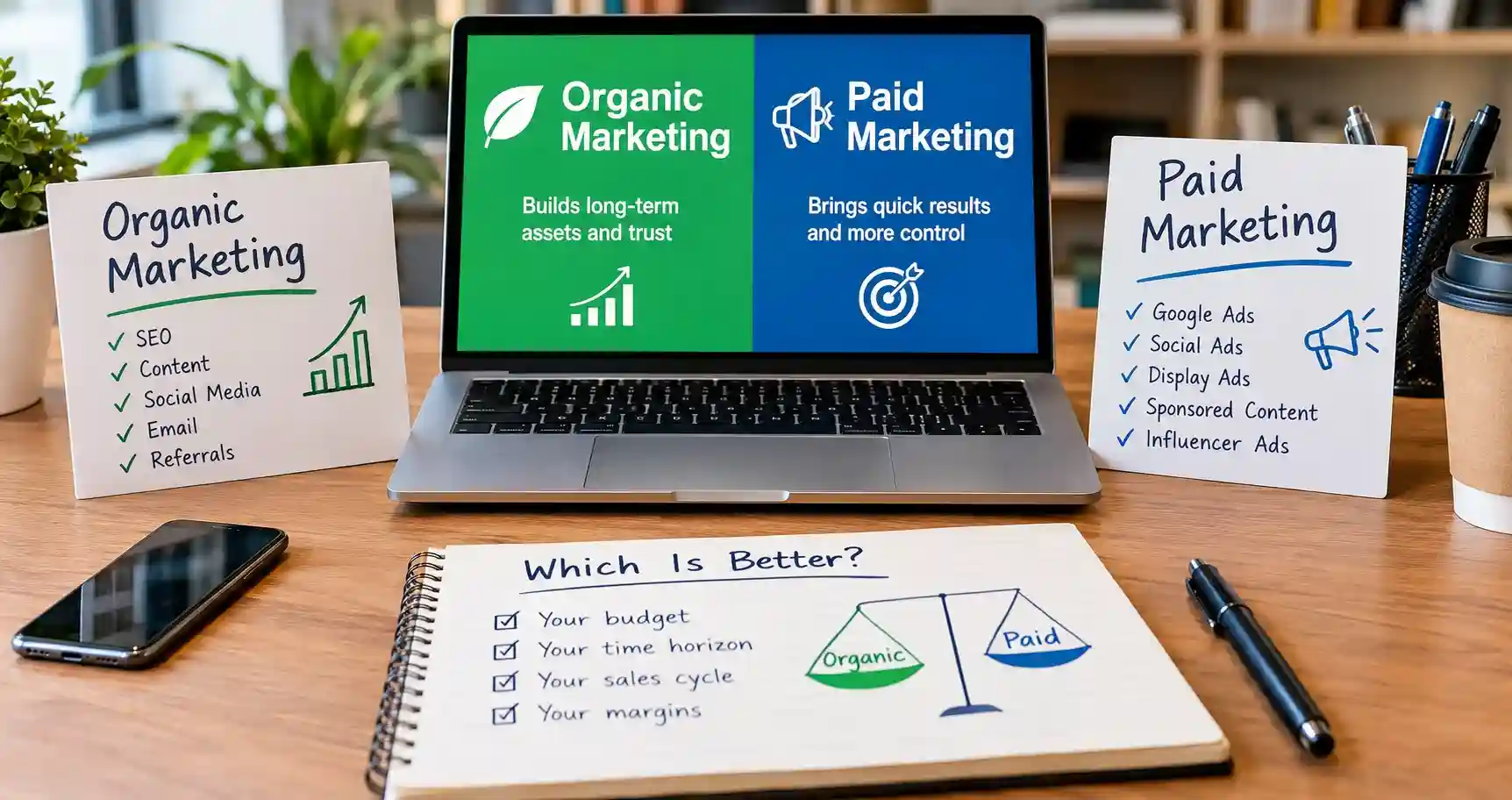
Neither is better in general. Organic marketing builds assets you own and can lower your cost of getting customers over time, but it is slow, and for search it is getting slower. Paid marketing buys attention immediately and is easy to measure, but it stops the day you stop paying, and clicks tend to get more expensive as competition grows.
For most small businesses, the practical answer is to use paid marketing to capture demand that already exists and to learn quickly, and organic marketing to build the assets that make customers cheaper to win later. Which one should lead depends on four things: your cash, your time horizon, the length of your sales cycle, and your margins. This guide shows how to weigh them, with real benchmarks and worked examples.
This guide is part of my online marketing guides. It also covers what AI search and the new ads inside AI products change about the comparison.
What organic and paid marketing actually mean
Organic marketing is attention you earn without paying for each view or click. Paid marketing is attention you buy. The line blurs in places, so it helps to see examples side by side.
| Organic marketing | Paid marketing | |
| Search | SEO, Google Business Profile, being cited in AI answers | Search ads, shopping ads, ads in AI results |
| Social | Posts, video, community, replies | Social ads, boosted posts, sponsored creators |
| Owned channels | Email to your own list, WhatsApp contacts, your website | Ads that send people to capture emails or sign-ups |
| Earned attention | Referrals, reviews, press, partnerships, word of mouth | Sponsorships, paid placements, paid influencer deals |
Some tactics sit in between. Retargeting is paid, but it works because of the visitors your organic efforts attracted. Sending free products to creators costs product rather than cash. Affiliate programs pay only when a sale happens. Do not get stuck on the label; ask whether you pay per view or click, and whether the result stops when payment stops.
The real differences
| Factor | Organic | Paid |
| Speed to first results | Weeks to months; search can take longer | Can start the same day |
| Cost structure | Mostly time, skills and tools | Cash for every click or view, plus creative and management |
| What you keep | Assets: rankings, content, list, reputation | Little once spend stops, except data and any list you captured |
| Scalability | Slower and harder to scale on demand | Scales quickly, up to the limits of demand and your budget |
| Targeting | You reach people who find you | You choose audience, place and time |
| Measurement | Slower and harder to attribute | Faster, more direct feedback |
| Main risk | Wasting months on topics that never rank or convert | Paying more for clicks than customers are worth |
Two points here are often muddled. First, organic is not free: it costs your time or someone else’s. Second, paid is not only for big companies: a small test budget can tell you quickly whether a message or keyword is worth building around.
How long does each take?
Organic search is slower than most guides admit
Ahrefs updated its large study of ranking speed in 2025. It found that only 1.74 percent of newly published pages reached Google’s top 10 within a year, down from 5.7 percent in 2017. The average page ranking number one was about five years old, and 72.9 percent of top 10 pages were more than three years old.
That does not mean SEO is pointless. It means a brand-new page rarely wins quickly for a competitive term, so you should expect to plan in months and years, target narrower searches first, and keep updating what works. These figures describe search rankings in one large dataset, not every organic channel.
Other organic channels can move faster
Email to people who already know you, referrals, community replies, a well-run Google Business Profile and partnerships can produce inquiries in weeks, because they rely on trust you already have rather than on rankings. When people say organic is slow, they usually mean organic search and content.
Paid is fast to launch, not always fast to profit
You can launch an ad campaign in an afternoon. But the first few weeks are mostly learning: which audience, message and page convert, and at what cost. If your landing page does not convert, fast traffic just means fast waste. Treat the first budget as a test with a clear question, not as a sales machine.
What does paid actually cost?
Cost is where many comparisons stay vague. For search ads, the WordStream and LocaliQ benchmark report gives useful anchors. Its 2025 edition, covering more than 16,000 US campaigns on Google and Microsoft Ads from April 2024 to March 2025, reported an average cost per click of $5.26, an average conversion rate of 7.52 percent and an average cost per lead of $70.11.
A May 2026 update is reported at about $5.42 per click, an 8.18 percent conversion rate and a $66.69 cost per lead, according to a summary of the 2026 edition; I have not seen the primary report, so treat those as approximate. The spread across industries is wide, from roughly $1.60 per click in arts and entertainment to $8.58 for attorneys in the 2025 edition. An all-industry average tells you very little about your market.
A worked example (illustrative numbers)
The numbers below are examples, not benchmarks. They show how to think, not what you will get.
- Suppose you pay $5 per click and 4 percent of visitors become leads. Your cost per lead is $5 divided by 0.04, which is $125.
- If a better page lifts the conversion rate to 8 percent, the same $5 click now costs $62.50 per lead. You did not change the ad; you changed what happens after the click.
- If 20 percent of leads become customers, a $62.50 lead means about $312.50 per customer. If a customer is worth $200 in profit, that campaign loses money. If the customer is worth $900 over a year, it may be worth running.
This is why page quality, follow-up speed and customer value matter as much as the ads. Cost per lead is not cost per customer, and neither tells you whether you are profitable until you compare it with what a customer is worth.
Organic is not free: count the real cost
A fair comparison counts the time you put into organic work. Here is an illustrative example of how to do it.
- You spend eight hours a week writing, publishing and replying. If your time is worth $25 an hour, that is $200 a week, or about $860 a month.
- Add $50 a month for tools. The monthly cost is about $910.
- If that work produces six leads a month, your cost per lead is about $152, higher than the paid benchmark above.
- But if the same content keeps producing leads next year with little extra effort, the cost per lead falls over time. That is the real argument for organic: it can compound, if it works at all.
The honest conclusion from this example is not that organic is cheaper. It is that organic is a bet on future cost savings, and you should make the bet only if you have the time and the patience to see it through.
How to decide: four questions
1. How soon do you need customers?
If you need revenue this month, organic search will not deliver it. Paid, referrals and outreach can. If you can wait six months or more, organic becomes more attractive.
2. How much cash and time do you have?
A small business with little cash but expertise and time should lean toward organic and use a small paid test to validate demand. A business with cash but little time may find paid, or hiring help, a better use of resources.
3. How long is your sales cycle, and how much is a customer worth?
A high-value service with a long decision process can afford a higher cost per lead, which makes paid more viable, and it benefits from the trust that content and reviews build. A low-margin, low-price product may not survive $5 clicks.
4. Is demand already there?
This is the question people skip. Paid search captures demand that exists: people already searching for what you sell. If nobody is searching for your new idea yet, search ads will find few people, and you need to create demand through content, community or paid social instead.
A quick decision table
| Your situation | Lead with | Why |
| Need customers soon, proven offer, a page that converts | Paid search, while building organic assets | Fast feedback on demand that already exists |
| Little cash, long sales cycle, expertise to share | Organic content, email and partnerships, plus a tiny paid test | Time is cheaper than clicks, and trust matters |
| Local service with high-intent searches | Both: Business Profile and reviews, plus local search ads for urgent phrases | People searching are ready to act |
| New product with no existing search demand | Organic community and paid social for awareness | You must create demand, not capture it |
| Low margins and expensive clicks | Email, referrals and organic, with tightly limited paid tests | Paid math may not work |
| Launch, sale or event | Paid for the spike, organic for the long tail | Paid is easier to time |
There is no universal split. I would be wary of any guide that gives you a fixed percentage between the two without knowing your margins and sales cycle.
How organic and paid work together
Almost every guide says use both. Here is what that means in practice.
- Test with paid, then build with organic. Run a small search or social campaign to find which keywords, messages and offers convert. Then build content and pages around the winners instead of guessing.
- Use organic proof to lower paid cost. Reviews, case studies and clear pages raise your conversion rate. As the example above shows, doubling it halves your cost per lead at the same click price.
- Retarget the people your organic work attracts. Remarketing to visitors costs money, but it reaches people who have already shown interest. Follow privacy and consent rules in your market.
- Capture emails from paid traffic. Anyone you pay to reach and who does not buy is worth inviting to a list you own, so your next message is free.
- Test before paying to protect your own name. Ads on your brand name can be wasted money for a well-known brand. In a large eBay field experiment, halting brand keyword ads led to almost no loss of traffic, as the paper reports. But a smaller brand may be different: a study of Edmunds, summarized in this VoxEU column, found that more than half of the paid traffic was lost when ads stopped, partly to competitors bidding on its name. The lesson is to test rather than assume.
What AI search changes in 2026
AI answers change both sides of this comparison, and most articles on the topic have not caught up.
Organic clicks are harder to earn
A Pew Research Center analysis of 900 US adults’ browsing in March 2025, reported by Search Engine Roundtable, found that users clicked a traditional result in 8 percent of visits when a Google AI summary appeared, compared with 15 percent when it did not. They clicked links inside the summary itself in only 1 percent of visits. Google disputed the study’s methodology, so treat it as one piece of evidence, not a final word.
The practical effect is that organic visits can fall even when your content is good. That is a reason to judge organic by leads, branded searches and inquiries, not visits alone.
Some of your organic traffic now has its own channel. Since May 13, 2026, Google Analytics has had an AI Assistant channel for visits from assistants such as ChatGPT, Gemini and Claude. Check it, and keep asking new customers how they found you, because influence from an AI answer often shows up later as a branded search.
Paid is moving into AI answers
At Google Marketing Live in May 2026, Google announced new ad formats for AI Mode and Search, including Conversational Discovery ads and Highlighted Answers, with some in testing and availability varying by market. OpenAI began showing labeled ads to logged-in users on ChatGPT’s Free and Go tiers in the US on February 9, 2026, and, per this guide to ChatGPT Ads, opened a self-serve Ads Manager in May. Availability differs by country and keeps changing, so check each platform’s current terms before planning around them.
So “paid” now includes placements inside AI products, and “organic” includes being cited or recommended in them. Google’s own guidance on AI features in Search says the established SEO fundamentals still apply and no special optimization is required, and nobody can guarantee a citation. I cover the practical steps in my guides to optimizing for AI search and Google AI Overviews and SEO.
How to compare them fairly
Use the same yardsticks for both channels, or the comparison is rigged from the start.
- Cost per lead and cost per customer. Include time for organic and management fees for paid.
- Payback period. How many months until a channel’s customers have paid back what you spent on it?
- Customer quality. Track which channel brings customers who stay, spend more or refer others, not just inquiries.
- Assets built. Rankings, email subscribers, reviews and branded searches are what organic leaves behind. Paid leaves mostly data.
- Attribution honesty. Last-click reports flatter paid, because ads often capture people your organic work already convinced. Where you can, test by pausing a campaign in one area or period, and ask customers how they heard about you.
A simple lead log and tagged links are enough to start. My digital marketing guides and content marketing guides go deeper on measurement and on building the organic side.
A simple starting plan by resources
| Your resources | Start with | Add later |
| Time only, no budget | Business Profile, a useful website, reviews, email list, one social channel | A very small paid test once your page converts |
| A small test budget | One search or social campaign with one clear question, plus the organic basics | More campaigns for what wins; content built around winning keywords |
| An ongoing budget | Paid on proven channels, organic content and email in parallel | Link building, video and partnerships to deepen organic |
If you choose to try paid social, my Facebook Advertising guides explain campaign structure and common problems. For the organic side, my SEO guides cover how search visibility works.
Common mistakes to avoid
- Treating organic as free and ignoring the hours it takes.
- Starting paid before the website or landing page converts.
- Judging organic after six weeks, or paid after three days.
- Quoting round numbers about ROI from articles that give no source.
- Optimizing for cost per click instead of cost per customer.
- Paying for clicks on your own brand name without testing whether you need to.
- Measuring organic only by visits when AI answers reduce clicks.
- Spreading across five platforms instead of doing one or two well.
- Stopping paid completely when it works, or relying on it so heavily that you never build assets of your own.
When it makes sense to get help
If the bottleneck is building or fixing the website, SEO or social work, my company Leelija provides web, app and software development alongside SEO and social media marketing. If the bottleneck for your organic growth is earning links from other sites, my team at FastLinky provides link building services. No provider can promise rankings or AI citations, so be wary of anyone who does.
Frequently asked questions
Organic marketing earns attention without paying per view or click, through things like SEO, content, email and referrals. Paid marketing buys attention through ads and sponsorships. Organic is slower and builds lasting assets; paid is faster and stops when the spending stops.
It depends on cash, time, sales cycle and whether demand already exists. Many small businesses do best by using a small paid budget to learn what converts and to capture existing demand, while building organic assets such as a Business Profile, reviews, a useful website and an email list.
No. It usually costs little cash but a lot of time, plus tools and sometimes help. Count your hours when you compare it with paid, or the comparison will flatter organic.
Organic search often takes months. Ahrefs found in 2025 that only 1.74 percent of newly published pages reached Google’s top 10 within a year. Other organic channels, such as email, referrals and a local profile, can work in weeks.
It is worth it when your cost per customer is comfortably below what a customer is worth, and your page and follow-up convert well. Test with a small budget and a clear question before you scale.
Test it. In a large eBay experiment, brand ads added almost nothing for a very well-known brand, but a smaller brand with competitors bidding on its name may lose traffic if it stops. Pause carefully in a test and watch total clicks and leads.
No universal split exists. It depends on your margins, sales cycle and how quickly you need results. Start from your cost per customer and what a customer is worth, then decide how much paid you can afford.
No, but it changes how to judge it. Clicks fall when AI summaries appear, so measure leads, branded searches and inquiries, not just visits, and keep your pages clear, specific and useful. Google says no special optimization is needed for its AI features.
Yes, and it often works best. Use paid to test and capture demand, organic to build trust and assets, retargeting to reach interested visitors, and email to keep the people you pay to reach.