
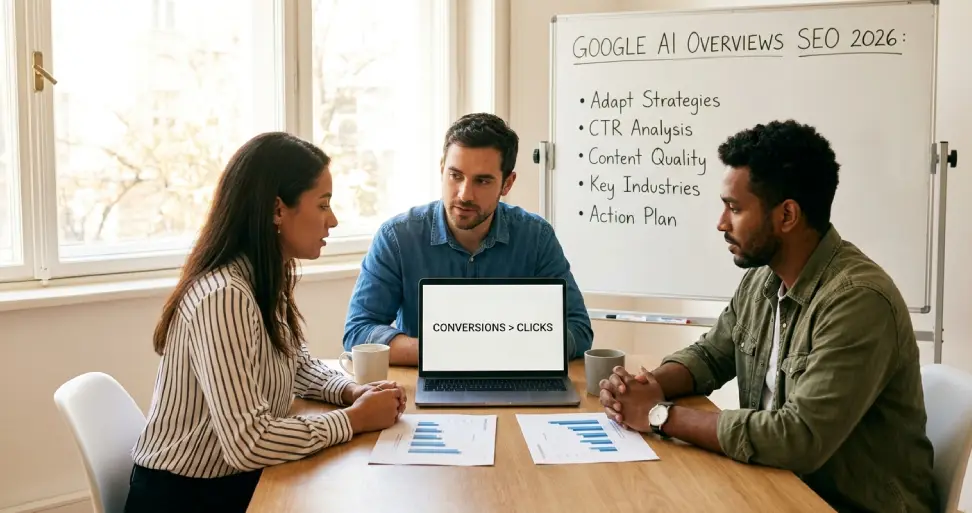
Google AI Overviews SEO means improving your content’s eligibility and usefulness as a source for Google’s AI-generated search summaries while protecting the value of your organic traffic. The foundation is familiar: accessible pages, relevant information, credible evidence, and a good experience for visitors.
The change is in what success looks like. A page can remain visible while fewer people click. Your content may also be cited in an answer without producing enough visits to support your business goals.
My recommendation is to work on two goals together: make your pages useful enough to support an answer, and give readers a worthwhile reason to visit. A citation is an opportunity. What happens after the click still matters.
What are Google AI Overviews
Google AI Overviews are generated summaries that appear for some searches and include links to supporting information. Google describes them as a way to help people understand a topic and explore it further. They are not shown for every query. See Google’s explanation of AI Overviews.
Do not treat every AI search feature as the same product. A featured snippet typically extracts information from one page. An AI Overview can bring information together from multiple sources. AI Mode provides a more interactive search experience, including follow-up exploration. Their results and supporting links can differ.
For an SEO plan, keep your observations specific. Record whether you saw an AI Overview, an ordinary search result, or a response in AI Mode. Combining them into one ranking number hides useful detail.
How is Google AI Overviews going to affect SEO?
AI Overviews can reduce the need to visit a website for an initial answer. They also create another place where information and brands can be discovered. The impact depends on the query, the answer shown, the competing results, and what the searcher needs next.
For business owners, I see three practical consequences. Rankings alone are less informative about traffic potential. Generic explanations need a stronger reason to earn a visit. Measurement needs to connect search visibility with useful actions such as inquiries, subscriptions, or purchases.
That does not make SEO obsolete. It makes the connection between visibility and business value more important. Your SEO strategy should still address discovery and relevance, while paying closer attention to what visitors gain from opening the page.
Google AI Overviews impact on SEO in 2026
Published research provides evidence of lower click-through rates, but the figures need context. A study published in 2026 may describe behavior observed during 2025. It should not be presented as a live measurement of every market today.
What the Ahrefs 2026 update found
In its February 2026 study update, Ahrefs reported that AI Overview presence correlated with a 58% lower average click-through rate for the top-ranking page relative to its modeled expectation.
The analysis used 300,000 keywords split between AI Overview queries and informational queries without an Overview. It compared aggregated desktop Search Console data from December 2023 and December 2025, using the non-Overview group to estimate the expected change.
This is evidence of a substantial risk in that dataset, not a prediction that your website will lose 58% of its traffic. It is an observational analysis with a modeled comparison, not a randomized test isolating every other change in Google Search.
What Pew Research observed
Pew Research Center’s July 2025 analysis examined browsing data from 900 US adults. Traditional result links received clicks on 8% of visits to search pages with an AI summary, compared with 15% without one. Summary links received clicks on 1% of visits to pages containing a summary.
The browsing activity came from March 2025; researchers collected corresponding search results in April. That timing matters because summaries can change. These findings describe the study’s sample and period, not a universal 2026 click rate.
The two studies measure different things. Ahrefs examined keyword-level desktop CTR for ranking positions, while Pew examined browsing behavior. Their percentages should not be added together or treated as directly interchangeable.
How common are AI Overviews, and why published figures disagree
You will see very different prevalence numbers depending on which vendor you read. That disagreement usually comes from methodology, not from a real dispute about the trend.
In its refreshed AI Overviews study, Semrush tracked more than 10 million keywords using its own database alongside Datos clickstream data. It found AI Overview presence starting at 6.49% of tracked keywords in January 2025, rising to nearly 24.61% by July 2025, then settling back to 15.69% by November 2025. The pattern was not a steady climb; it was a rapid rollout followed by a pullback.
Ahrefs measures the same feature a different way. Its study of 55.8 million AI Overviews counted against Ahrefs’ own 590-million-keyword desktop index found AI Overviews on 9.46% of indexed keywords and roughly 12.8% of total search volume, with US desktop coverage closer to 16%. Ahrefs also noted that its figure likely understates true prevalence, since its index under-samples one-off queries and logged-out results.
Neither figure is wrong. They describe different denominators, different countries, and different points in a volatile rollout. The practical lesson is to stop looking for one industry-wide percentage and start measuring your own query set in Search Console or a rank tracker, since informational, long, non-branded, and non-local queries consistently show AI Overviews more often than commercial, short, branded, or local ones.
Which industries see AI Overviews most often
Semrush’s industry breakdown, drawn from the same keyword study, found Science, Computers & Electronics, and People & Society carrying AI Overviews on more than 17% of their keywords, while Real Estate, Shopping, and Arts & Entertainment stayed under 3%. Health, People & Society, and Law & Government saw some of the largest increases, which matters for any business writing in a regulated or advice-heavy niche.
This lines up with what Ahrefs found from the opposite direction: AI Overviews skew toward informational, non-branded, non-local searches on largely non-monetized terms. Shopping and real estate queries carry too much local and transactional intent for a synthesized answer to satisfy the searcher, so Google leans on maps, listings, and ads instead.
- A publisher or education site in a Science, Health, or Computers & Electronics niche should expect AI Overview exposure on a large share of its informational pages and plan accordingly.
- A real estate, retail, or local service business will see AI Overviews far less often, so ranking position and local pack presence likely still explain more of any traffic change than AI Overviews do.
- A B2B or SaaS site should watch its commercial and comparison queries specifically, since AI Overview coverage of commercial and transactional intent has been growing even where informational coverage has levelled off.
What this means for your business
My interpretation is that you should test your exposure instead of applying an industry headline to your entire website. Start with the pages responsible for meaningful traffic or conversions, then inspect the queries behind them.
A publisher funded by page views may face different pressure from a service business that needs a small number of qualified inquiries. A lower click count is a concern, but the business response depends on which visits were lost and whether valuable outcomes changed.
Which pages should you review first?
I would prioritize pages using their business importance and the ease with which a short answer could satisfy the reader. The following table is a planning framework, not a measured ranking of risk.
| Page type | Question to investigate | Useful improvement |
|---|---|---|
| Short definitions | Can the search page satisfy the entire need? | Add relevant examples or a useful next task |
| General tutorials | What does the reader need to apply the answer? | Add screenshots, troubleshooting, and templates |
| Product comparisons | Can the reader judge the options reliably? | Explain criteria, evidence, limitations, and fit |
| Service pages | Is the offer clear enough to evaluate? | Explain scope, process, proof, and contact options |
| Original research | Can others understand and verify the findings? | Publish methods, dates, sample details, and supporting data |
Do not remove a helpful definition simply because it may be summarized. It can still support readers, navigation, and related pages. Improve it when you have something useful to add; avoid inflating it with irrelevant material.
What Google actually requires for AI Overviews
Google says pages must be indexed and eligible to appear in Search with a snippet to qualify as supporting links in AI Overviews or AI Mode. It specifies no extra technical requirements or special AI schema. Eligibility does not guarantee selection. These points are set out in Google’s AI features documentation.
Start with a technical check on the page you want to improve. Confirm that it returns successfully, has no unintended noindex instruction, and identifies the intended canonical URL. Review robots rules and hosting security if Google cannot access the content.
Use Search Console’s URL Inspection tool to examine Google’s indexed information and run a live test. Check the actual content received rather than relying only on the fact that the page opens in your own browser.
Googlebot is relevant to Google Search, including its AI features. Google-Extended is a separate control for certain other AI uses. Do not block the wrong crawler while trying to change your search visibility.
How to improve your Google AI Overviews SEO
Answer a specific question clearly
Begin an important section with the answer, then explain the conditions, reasoning, and practical steps. A reader should not have to work through several promotional paragraphs to discover whether the page addresses their problem.
For example, a page about choosing billing software should explain which features a small shop needs and why. Separate essential requirements from optional conveniences. If an answer depends on the shop’s size or workflow, say so near the recommendation.
I use clarity as an editorial standard, not as a guaranteed citation technique. There is no need to force every section into an identical word count.
Add something the summary cannot fully deliver
Google’s guidance for succeeding in AI search experiences emphasizes distinctive content that satisfies visitors. That is a useful test for your next update: what does this page contribute beyond information already available elsewhere?
Consider a tutorial about importing products into inventory software. A short summary can list the steps. Your page can provide an example import file, explain field mappings, show error messages, and demonstrate how to verify stock totals afterward.
Those additions serve someone completing the task. They also create a genuine reason to open or bookmark the page. Do not hide the basic answer merely to force a click; make the full experience valuable.
Support claims with evidence and context
Use original work when available, and make its scope clear. For a case study, include the period, starting conditions, changes made, and limitations. For a tool comparison, distinguish hands-on testing from a review of published specifications.
Link external claims to the exact source that supports them. Include dates with changing figures, such as prices or research results. Avoid presenting an old study as new because the article carries a 2026 title.
Google’s people-first content guidance provides useful questions about originality, authorship, and trust. My advice is to use them before publication and during substantial updates.
Connect related content naturally
A useful article should help readers continue when they need more detail. Link a general explanation to a relevant tutorial, comparison, or service page using descriptive anchor text.
Google’s link guidance explains the importance of crawlable links and meaningful wording. The purpose is to connect useful pages, not to insert as many links as possible.
For example, my content marketing guides explore how content supports business goals beyond one search result. That broader planning becomes important when different pages contribute at different stages of a customer’s decision.
Use accurate markup and a usable page
Use structured data that fits the visible content. An article can use accurate author and publication information, while a product page needs truthful product details. Follow Google’s structured data guidance, and avoid conflicting markup from multiple plugins.
Markup does not certify expertise or guarantee an AI citation. FAQs should answer real questions rather than exist solely to support schema.
Make the page comfortable to use on mobile. Keep the main answer readable, prevent intrusive elements from obstructing it, and test useful downloads or forms. A search visit has little value if the reader cannot complete the next step.
How to check whether AI Overviews are affecting your traffic
Start with a focused group of queries and their landing pages. Compare periods of similar length, separating device and country where the data supports it. Consider seasonality and changes in query mix before drawing a conclusion.
Look at impressions, clicks, CTR, and position together. Then inspect current results and any historical SERP records you have. A screenshot taken today cannot prove what appeared last month.
| What you observe | Possible explanation to test | Next step |
|---|---|---|
| Impressions stable but clicks lower | CTR changed because of result layout, intent, or presentation | Compare relevant search results and title alignment |
| Impressions and clicks both lower | Demand, indexing, ranking, or query coverage changed | Inspect indexing and the queries losing visibility |
| Position looks stable but traffic falls | Query mix or search features changed | Segment data and review result types |
| Citations appear but inquiries decline | Visibility is not reaching or converting the right audience | Review landing-page fit and inquiry quality |
These are diagnostic starting points. None proves that AI Overviews caused the change. Competitor improvements, advertising, technical faults, or shifts in demand may also be involved.
Understand the Search Console reporting limits
Google currently reports traffic from its AI search features within the overall Web search type. Do not label all organic Google traffic as AI Overview traffic.
There is also a position detail worth knowing: an AI Overview occupies one position, and its links share that position in Search Console reporting. An external link click counts as a click. Google explains this in its impression, position, and click documentation.
This means an average position figure should not automatically be interpreted as the location of your ordinary blue link. Combine Search Console with a dated observation log or a SERP tracking tool, and document the limits of the sample.
Measure business results alongside traffic
Imagine an illustrative page receives 1,000 visits and 20 inquiries in one period. Later, it receives 700 visits and 21 inquiries. Visits fell 30%, while the inquiry rate increased from 2% to 3%.
That does not prove AI Overviews improved the traffic. It shows why a traffic-only report can miss part of the business picture. You still need to inspect inquiry quality, completed sales, and other changes during the period.
I recommend tracking three groups separately: search performance, observed citation visibility, and business outcomes. Give each metric a clear definition, and avoid combining them into a score that nobody can explain.
For a publisher, outcomes may include subscriptions and engaged return visits. For an agency, they may include qualified consultations. For a store, they may include completed purchases and repeat customers.
A focused action plan for the next month
Choose five important pages rather than rewriting the whole website at once.
- Week one: Record baseline search performance, relevant queries, conversions, and observed AI Overviews. Resolve obvious access problems.
- Week two: Improve unclear answers and add evidence or practical resources where they help the reader.
- Week three: Review internal links, page usability, author details, and accurate structured data.
- Week four: Repeat your observations, review early outcomes, and choose the next improvements. Allow more time where traffic is too low to support a conclusion.
Keep a change log. If you change the title, offer, layout, and main content simultaneously, you will have difficulty knowing which adjustment mattered. The first month establishes a disciplined process; it is not a deadline for guaranteed rankings.
Frequently asked questions
It can be eligible if its pages meet Google’s requirements, but inclusion is not guaranteed. Focus on questions where you can provide specific, reliable information rather than assuming that publishing a longer article will beat a larger website.
No. Traditional ranking position and citation selection are different observations. Track the actual supporting links for your target queries instead of assuming that one determines the other.
Google says no special structured data or AI text file is required for its AI search features. Use appropriate markup to describe your visible content accurately, and prioritize accessible, useful pages.
Google documents controls include nosnippet, data-nosnippet, max-snippet, and noindex. They have different effects and can affect ordinary Search as well. Review the snippet controls and the AI features documentation before changing them. Blocking Googlebot is not a targeted AI Overview opt-out.
No. Publish them when they serve your audience and connect to useful next steps. Invest in explanations, tools, examples, and evidence that help readers do more than obtain a short definition.
My priority would be to connect SEO decisions to customer needs and measurable outcomes. Keep your technical foundation sound, strengthen the pages that matter, and assess clicks, citations, and business results separately.
Growth has not been a straight line. Semrush’s tracking showed AI Overview coverage rising sharply through mid-2025, then pulling back by November 2025, with informational queries still dominant but commercial, transactional, and navigational coverage all increasing. Treat any single prevalence figure as a snapshot, not a forecast, and re-check your own query set periodically rather than relying on one study’s number for the rest of the year.