

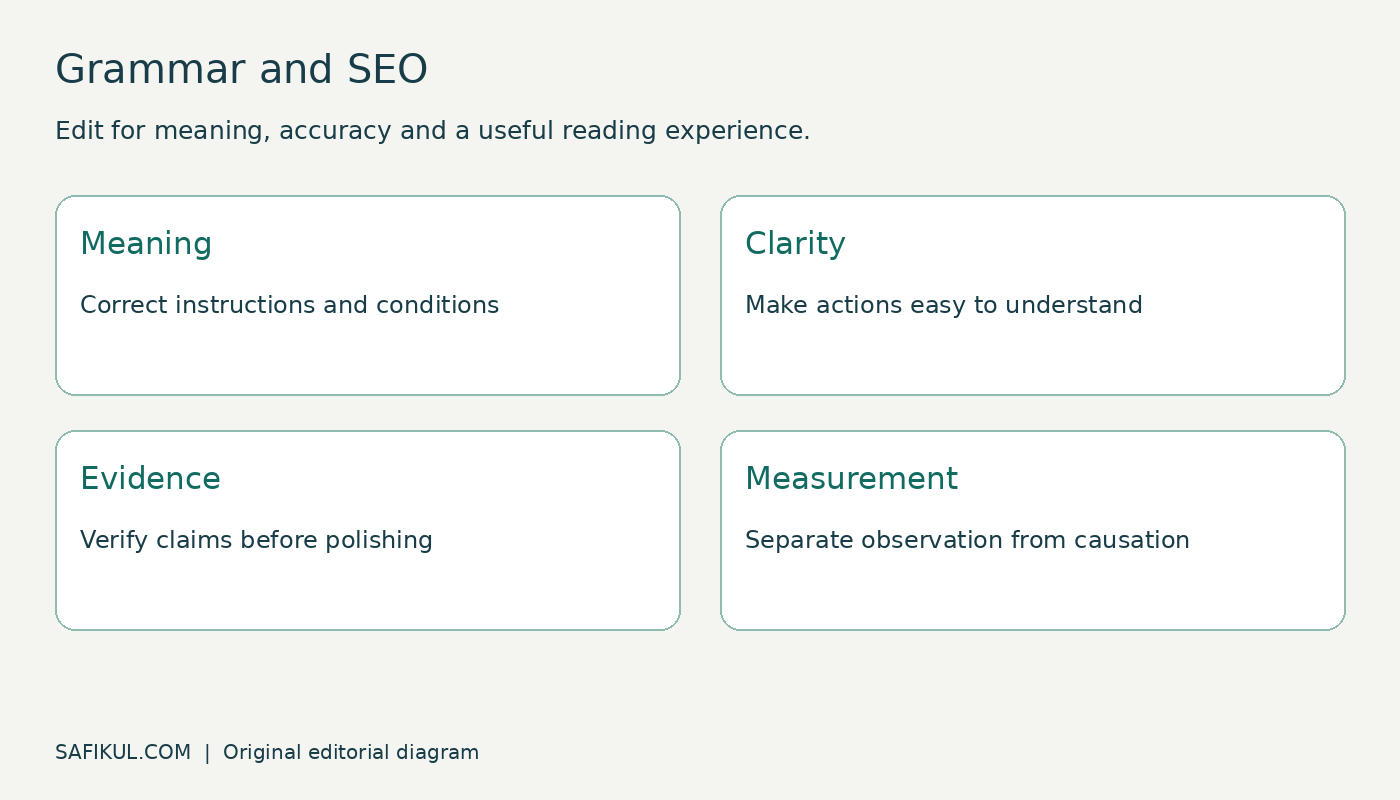
Is grammar considered a Google ranking factor? There is no published universal grammar score or error threshold that tells you where a page will rank. Google’s current guidance does ask publishers to check spelling, style and readability. The practical conclusion is to edit for accurate meaning and a useful reading experience, without promising that correcting a few commas will raise rankings.
For a business owner, the more useful question is which writing problems stop a reader from understanding or trusting the page. An unclear delivery condition or an incorrect instruction deserves attention before a harmless preference about sentence style.
This guide separates what Google’s documentation supports from what an editor can reasonably test. For the wider picture, see my Google ranking factors guide.
What Google’s guidance actually says
Google’s helpful-content guidance includes spelling and stylistic issues in its self-assessment questions. It also asks whether content is well produced, accurate and valuable to readers. These are useful editorial questions; the page does not assign a numerical ranking weight to a grammar-checker score.
The SEO Starter Guide recommends readable, well-organized writing and checking spelling and grammar. That supports proofreading as good publishing practice. It does not establish that every typo causes a ranking penalty.
My interpretation is that you should avoid both extremes: ignoring errors because grammar is supposedly irrelevant, and treating perfect grammar as a substitute for a helpful answer. A polished paragraph can still be wrong, outdated or unrelated to the reader’s question.
A quality recommendation is not a disclosed ranking formula
A checklist can tell you how to improve a page without revealing precisely how a search system scores it. Keep three kinds of evidence separate:
| Evidence | What it supports | What it cannot prove alone |
|---|---|---|
| Google recommends proofreading | Writing quality deserves editorial attention | A fixed ranking gain for each correction |
| A successful page contains mistakes | Perfect grammar is not necessary in every observed result | Errors never matter to comprehension or quality |
| Traffic rises after an edit | A change occurred after publication | Grammar caused the increase |
| A grammar tool gives a high score | The text meets that tool’s criteria | Google uses the same score |
Google also explains that search quality raters do not directly control page rankings and that their ratings are not used directly in ranking algorithms. Do not convert an evaluator’s quality guideline into a claim that Google counts grammatical errors with the same checklist.
Prioritize errors by their effect on meaning
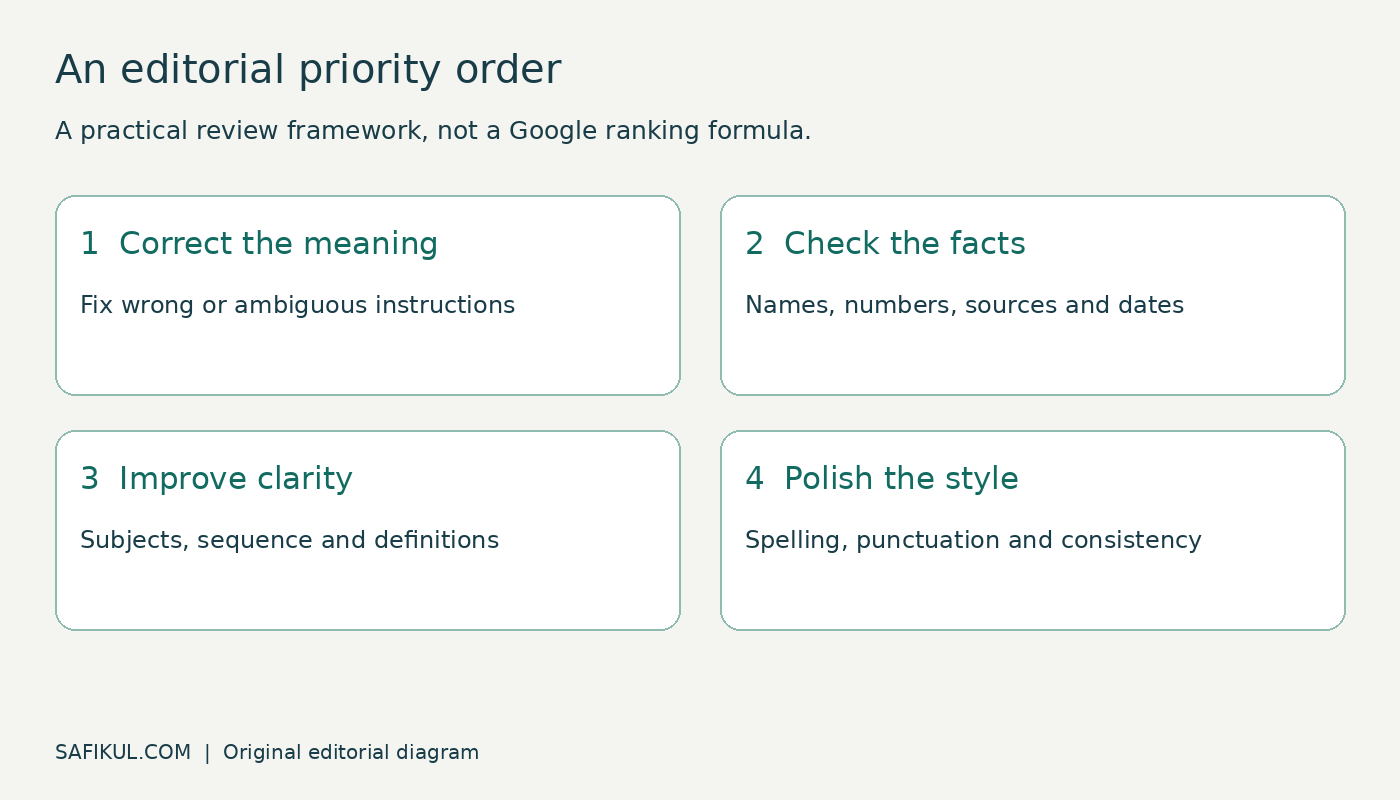
I recommend reviewing the consequences of an error before its label. A missing word can reverse an instruction. A vague pronoun can make a troubleshooting step impossible to follow. Those are more important than whether an editor prefers a shorter sentence.
| Priority | Illustrative issue | Useful correction |
|---|---|---|
| First | An instruction says to delete a file when it means not to delete it | Correct the action and verify the procedure |
| Next | A price, deadline or condition is ambiguous | State the exact condition in plain language |
| Then | A sentence has several possible subjects | Name the person, tool or page responsible |
| Later | Harmless punctuation or regional spelling inconsistency | Apply the site’s style convention |
For example, “After changing the setting it should work” leaves the reader guessing. “After saving the shipping zone, reload checkout and check whether the delivery method appears” identifies an action and a visible result. This is an illustrative rewrite, not a claim that a specific wording earns a ranking boost.
A practical editing workflow for existing articles
1. Confirm the page still answers the question
Read the title, introduction and main headings. Write down the reader’s task in one sentence. If the article does not fulfil it, grammar correction alone will not solve the problem. My content gap analysis guide helps identify missing information.
2. Check facts before polishing sentences
Verify product names, dates, units, links and instructions against appropriate sources. An elegant sentence with an incorrect specification is still a bad answer. Keep technical terms, command names and code unchanged unless you have checked the underlying detail.
3. Edit for comprehension
Read each section aloud. Break up sentences that hide the action. Replace an unclear “it” or “this” with the relevant subject. Define unfamiliar terms near their first use and make the sequence of steps explicit.
4. Use a grammar tool as a reviewer
Review suggestions individually. A tool can flag repetition or agreement problems, but it can also misunderstand brand names, regional English, quotations or specialist language. Accept a change only when it preserves the meaning and suits the audience.
5. Check the published page
Read the saved version on a phone. Check headings, lists, tables, links and any code samples affected by the edit. A clean document can still become a confusing page if formatting or copy-and-paste changes the instructions.
Preserve the author’s voice and regional English
Clear writing does not require every author to sound identical. Indian, British and American English can use different legitimate spellings and expressions. Choose a style that suits your audience and use it consistently; do not call every regional difference an error.
For Safikul.com, I prefer practical explanations with recognizable business examples. A sentence can be conversational and still precise. The goal is for the reader to understand what to do and why, without needing to decode unnecessary jargon.
When reviewing quotations, preserve what the source actually said or clearly paraphrase it. When reviewing a technical tutorial, protect literal text such as a menu label, file path or parameter. Automatic rewriting can accidentally change the thing the reader must type.
How to evaluate a grammar-focused update
Record the page, date and kind of edit. Separate factual corrections, structural rewrites and grammar-only changes in your notes. If you change the title, add substantial content and fix spelling together, any later movement cannot honestly be attributed to spelling alone.
Use Search Console to compare relevant queries and pages over meaningful periods. Account for demand changes, seasonality, indexing issues and wider site changes. Google’s traffic-drop investigation guide explains why search performance needs a broader diagnosis.
Also evaluate outcomes closer to the writing itself. Can a reader explain the instruction correctly? Are support questions about that step less frequent? Do people complete the intended task? These are practical evaluation ideas, not claims that Google uses your support volume or task-completion metric as a ranking factor.
For a small site with little traffic, accept that the available data may not establish a ranking effect. You can still fix an unclear instruction because it is demonstrably unclear.
What not to do
- Do not claim that a score of 100 in an editing tool guarantees first-page rankings.
- Do not add deliberate spelling mistakes to make writing look human.
- Do not force an awkward exact-match keyword into an otherwise clear sentence.
- Do not rewrite an entire useful archive solely because one article has a typo.
- Do not assume that a traffic drop immediately after an edit proves the edit caused it.
A proportionate review starts with important pages and errors that change meaning. Put smaller cosmetic improvements into normal maintenance rather than treating them as an emergency SEO project.
Frequently asked questions
Can a page with spelling mistakes still rank?
A page’s usefulness cannot be judged by proofreading alone. Do not treat a mistake on a visible result as proof that errors have no consequences. Correct errors on your own pages when they reduce clarity or accuracy.
Does Google use my grammar-checker score?
The documentation discussed here does not establish that Google uses a commercial editing tool’s score. Treat the score as an editing aid, not a measurement of ranking eligibility.
Should I correct old posts?
Yes, when the correction makes them more accurate or easier to use. Start with incorrect instructions, important offers and frequently read pages. Preserve useful examples and working links during the update.
Will AI proofreading improve SEO?
It may help you notice writing problems, but the result needs human review. Check facts and meaning after rewriting. Neither the use of AI nor a polished writing style guarantees search visibility.
Edit because your readers deserve a dependable explanation. Combine that work with relevant content, sound technical access and useful navigation, as described in my SEO best-practices checklist.