

Google ranking factors are the signals Google’s systems use to assess which pages are relevant and useful for a search. For a business website, the most productive priorities are answering the right question, providing credible information, earning relevant links and making the page work well. There is no public formula that assigns a fixed percentage to every factor.
When I review an SEO plan, I want to know what is stopping a useful page from reaching the right reader. A list of hundreds of possible signals does not answer that question. A clear diagnosis does.
This guide separates documented ranking considerations from technical requirements, useful publishing practices and claims that should not become your strategy. It covers organic Google Search; local map results and product listings have additional requirements. Guidance was checked on 24 October 2026.
Google ranking factors at a glance
Use this table to decide where to investigate. The order is a practical review sequence, not Google’s weighting of its algorithm.
| Area | What it means | First action |
|---|---|---|
| Technical eligibility | A prerequisite for indexing, not a ranking bonus | Inspect the URL and check access |
| Relevance and intent | The page addresses the searcher’s task | Compare the answer and format with the query |
| Quality and reliability | The information deserves the reader’s confidence | Check evidence and missing explanations |
| Links | Connections help discovery and understanding | Review relevant internal and earned links |
| Page experience | The page is usable; Core Web Vitals are used in ranking | Test important mobile page templates |
| Freshness | Current information matters for some queries | Update facts that have actually changed |
Why a list of 200 factors can be misleading
Google’s ranking systems guide describes multiple systems, including language understanding, link analysis and freshness. It does not publish an exhaustive checklist or universal weights. Systems assess individual pages while also using some site-wide signals.
A ranking factor, a ranking system and an SEO task are different things. Adding a sitemap is a task. PageRank is part of Google’s link analysis systems. A third-party authority score is a tool’s measurement. Putting them in one numbered list makes them look equivalent when they are not.
My rule is to ask three questions before funding an SEO recommendation: What is the evidence? Which page problem will this address? How will we know whether it helped? If the answer is only “a competitor does it,” the recommendation needs more work.
1 Match the search intent before expanding the article
Search intent is the task behind a query. Someone searching “SEO audit checklist” probably needs a usable checklist. Someone searching “SEO audit service” may be evaluating providers. The shared words do not make the two pages interchangeable.
Google explains that systems such as RankBrain and neural matching interpret concepts and relationships. Exact phrase repetition is therefore a poor substitute for a relevant answer.
I would review a small set of current results in the target market and record the dominant page type, the reader’s starting knowledge and the decision each page helps them make. Then I would identify an unanswered practical question. This is an editorial exercise, not permission to copy competitors’ headings or examples.
For example, a hypothetical retailer targeting “inventory spreadsheet” could offer an editable sheet, setup instructions and an explanation of returns. Publishing a general essay about inventory management would leave the most immediate need unresolved.

2 Make the answer useful enough to act on
Google’s helpful-content guidance asks creators to evaluate originality, completeness and whether readers leave satisfied. It also says there is no preferred word count.
For me, completeness means covering the decisions a reader must make. A troubleshooting article should explain what to check, what each result means and what to do next. A comparison should define its criteria and disclose meaningful limitations. More paragraphs are helpful only when they remove uncertainty.
Before adding another section, test the page with a concrete task. Could a beginner follow the instructions without guessing a missing step? Could a buyer tell which option fits their constraints? Could an experienced reader verify the important claim?
A useful content strategy also prevents repeated pages from answering essentially the same question. Give each article a distinct purpose and connect the pages that help a reader progress.
3 Build trust with evidence and honest authorship
E-E-A-T stands for experience, expertise, authoritativeness and trustworthiness. Google says E-E-A-T itself is not a specific ranking factor, and quality raters do not directly set rankings. It is a framework for thinking about qualities that reliable content should demonstrate.
For a business blog, I recommend showing who wrote the article, linking primary sources beside factual claims and clearly labeling illustrative examples. If a review relies on documentation, say so. If you performed a test, describe the method and conditions rather than presenting a screenshot without context.
Consider two claims: “This change increased sales” and “In our test, sales increased after this change, but we also changed pricing.” The second is less dramatic and much more useful. Readers need to understand what the evidence supports.
An impressive biography cannot repair inaccurate advice. Review the actual answer before adding badges, credentials or author markup.
4 Earn relevant links and connect useful pages
Google confirms that PageRank remains part of its core systems. That does not reveal the value of any individual backlink or establish a minimum number needed to rank.
Internally, use links where the next page genuinely helps. Google’s link guidance recommends crawlable links and descriptive anchor text. A phrase such as “how to check incoming links” tells the reader more than “click here.”
Externally, I would focus on publishing something another editor has a reason to reference: a well-explained finding, a useful calculator, an original example or a resource that saves their audience work. Promotion should introduce that resource to relevant people.
Use a backlink checker to investigate patterns, not to treat a domain score as Google’s own rating. A link from an unrelated page with no useful context deserves scrutiny even if a tool assigns it impressive metrics.
Google’s spam policies prohibit buying or selling links to manipulate rankings. Advertising links should be appropriately qualified. A package promising hundreds of ranking links is not a substitute for a credible publication strategy.
5 Fix technical eligibility before chasing small improvements
Google’s technical requirements include an accessible page, a successful HTTP response and indexable content. Meeting those requirements does not guarantee indexing.
For an important page that is absent from Search, start with URL Inspection in Search Console. Check whether Google can access the page and which URL it treats as canonical. Look for an accidental noindex directive, a login requirement, a server error or a conflicting canonical setting.
Do not remove intentional protections from customer accounts, checkout pages or private material just to make a report greener. The objective is to make the right public pages accessible.
My recommended handoff to a developer contains the affected URL, observed symptom, expected behavior and a way to verify the repair. “Improve technical SEO” is too vague to assign or test.
6 Improve page experience where users encounter friction
Google’s page-experience documentation states that Core Web Vitals are used by its ranking systems. It also makes clear that a perfect report does not guarantee top rankings and that there is no single page-experience signal.
The Core Web Vitals metrics cover loading, responsiveness and layout stability: LCP, INP and CLS. Use field data where available, and diagnostic tests to investigate what is causing a problem.
I would start with a real phone visit to an important page. Does the main answer appear promptly? Does a banner cover it? Does a button move just as you tap it? Does the navigation work? These observations help connect a technical report with a reader’s experience.
Fix repeated template problems before polishing an isolated score. An oversized image used across many articles can be a better first project than a tiny improvement on a rarely visited page.
7 Keep facts current when the query needs freshness
Google documents freshness systems for queries where recent information is expected. A current software-price comparison needs a different review schedule from an explanation of a stable mathematical concept.
Create a review trigger for each important article. Pricing pages need checks when the provider changes plans. Tutorials need checks after interface changes. A dated study needs its collection period visible so the reader can judge its relevance.
When updating, record what changed: a removed feature, a corrected instruction or a new source. Changing the year in the headline without improving the answer gives readers little reason to trust the update.
Claims I would not use as a ranking strategy
| Claim | More useful interpretation |
|---|---|
| A longer article always wins | Cover the task fully; avoid padding to hit a word count |
| A high SEO-tool score proves Google trusts the page | Use the score to find checks, then inspect the page |
| Schema guarantees a higher position | Appropriate markup can support eligible search appearances |
| Every page needs a new date each month | Update when facts or the reader’s needs change |
| A keyword density target unlocks rankings | Use natural language and answer related questions clearly |
| One analytics metric reveals the algorithm | Investigate the user’s task and the broader evidence |
Google’s SEO Starter Guide rejects several common shortcuts, including magical word-count targets. Its structured-data guidance describes markup as a way to explain content and enable eligible rich results. Neither offers a ranking formula.
I also would not buy artificial clicks to improve a supposed engagement signal. A short visit may mean the reader immediately found a phone number. A long visit may mean the instructions were confusing. Your analytics needs interpretation before it becomes a business decision.
What changes for Google AI Overviews and AI Mode
Google’s AI-features guidance says the established SEO foundations still apply. A supporting page must be indexed and eligible to appear with a snippet. There is no special AI schema or additional machine-readable file required for these features.
My practical recommendation is to make important passages independently understandable. Define the subject, give the direct answer and place the supporting evidence nearby. Keep essential explanations in text even when an image illustrates them. These choices improve readability; they do not guarantee an AI citation.
Measure citations separately from visits and leads. An answer can mention a business without linking to it, and a citation does not prove that a reader clicked. My guide to tracking AI search visibility explains how to keep those observations separate.
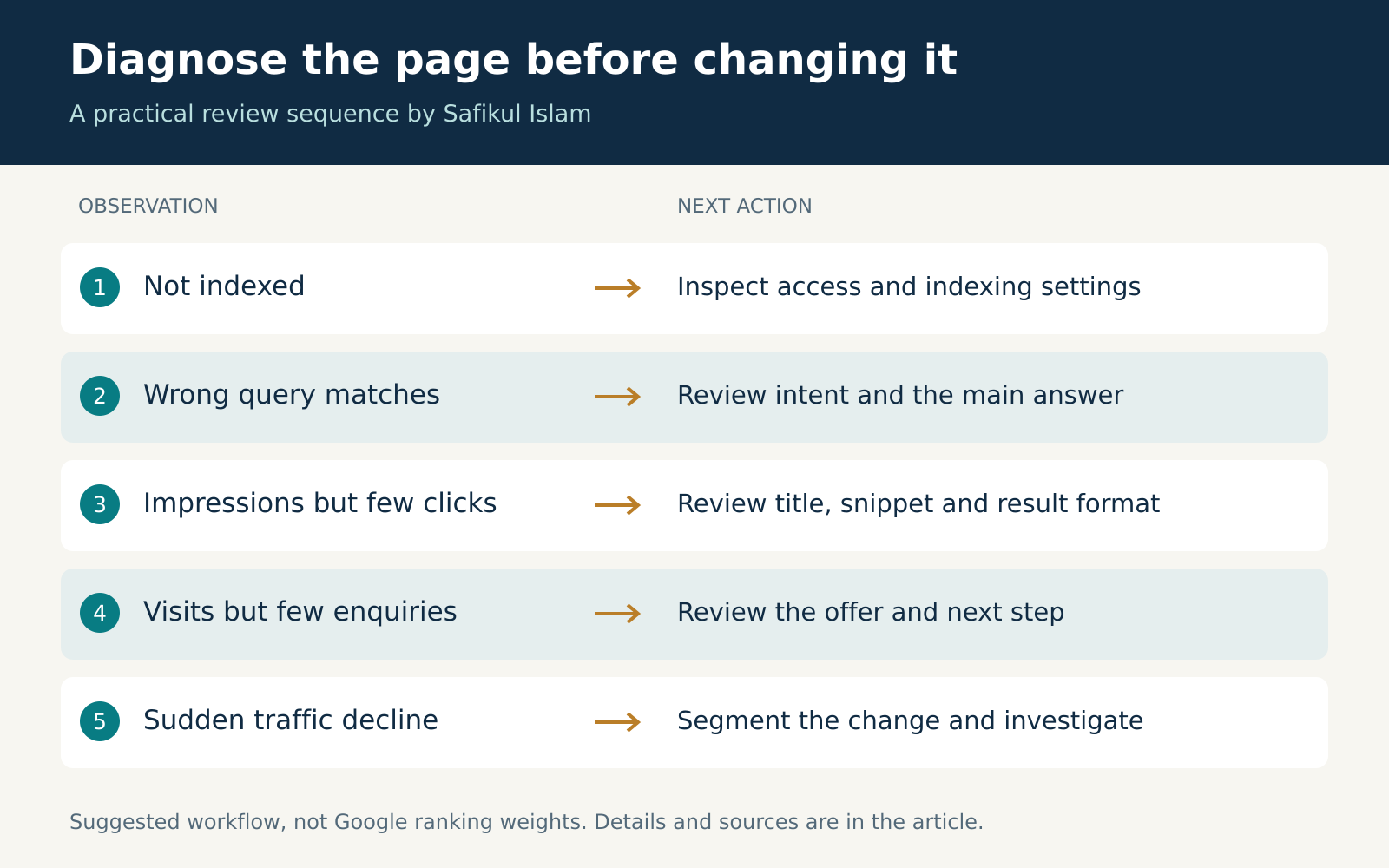
How I would diagnose a page that is not performing
Use the first observed problem to choose the next action. This is my recommended workflow, not a reverse-engineered Google algorithm.
- Not indexed: inspect access, indexing directives and canonical selection before rewriting the article.
- Indexed but showing for the wrong queries: examine the page’s purpose, title and main answer.
- Relevant impressions but few clicks: compare the title, snippet and competing result formats for those queries.
- Relevant visits but few enquiries: check whether the offer and next step match the visitor’s need.
- A sudden decline: investigate affected pages, countries and devices before assuming a single ranking factor changed.
Google’s traffic-drop guidance discusses multiple causes, including technical problems and changes in demand or ranking systems. My Google Trends guide can help you investigate seasonality. For visits that fail to produce enquiries, start with why a website gets traffic but no leads.
Frequently asked questions
What is the most important Google ranking factor?
There is no published universal number-one factor for every query. Start with whether the page can be indexed and whether it gives the searcher a useful, credible answer. Then investigate the specific weakness that limits the page.
Are backlinks still important?
Yes. Google continues to use link analysis, including PageRank. That does not mean every link helps equally or that buying more links will improve rankings.
Is E-E-A-T a direct ranking factor?
No. Google explicitly distinguishes E-E-A-T from a specific ranking factor. Use it to evaluate the trustworthiness of your content rather than to invent an E-E-A-T score.
Can a small website compete with a large brand?
A small site can publish a more useful answer for a specific need, but outcomes depend on the query and competition. I would start with a task where the business can contribute concrete evidence or a particularly helpful resource.
Does ranking first guarantee an AI citation?
No. Treat organic position, AI citations and business results as separate observations. Improve the page for the reader, then measure each outcome.
What I would prioritize this week
Select one important public page. Verify its eligibility, write down the task it should solve and identify one missing piece of evidence or explanation. Fix that weakness, add useful internal links and record the change date. Use my SEO best practices checklist to turn the review into a repeatable publishing routine.