

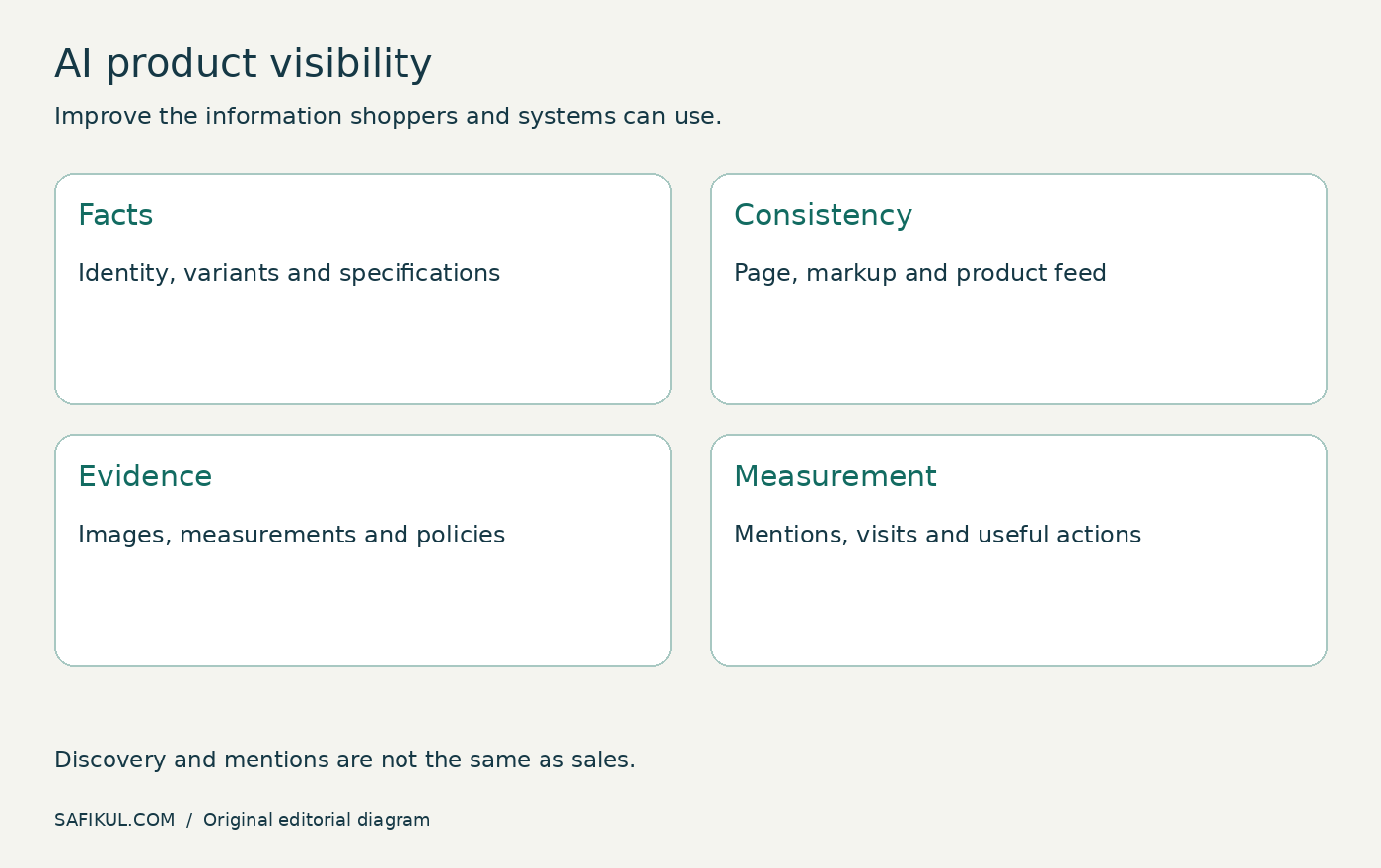
AI optimization for product visibility means making your products easy to discover, understand and compare through accurate product pages, consistent commerce data and credible supporting information. It does not mean adding a special “AI ranking” tag or paying for a promise that an assistant will recommend your brand.
My starting point would be the product itself: can a buyer confidently tell what it is, who it suits, what it costs and what happens after ordering? If those answers conflict across the page and your product feed, an AI visibility subscription will not fix the underlying information.
This guide is for small ecommerce teams improving existing product pages. It focuses on the work you control, with Google-specific guidance labelled clearly rather than treating every AI search service as the same system.
Understand the three different outcomes
| Outcome | What it means | What it does not prove |
|---|---|---|
| Product discovered | A system can find product information | That it will recommend the item |
| Product mentioned or cited | An answer includes the product or a source | That a shopper visited or purchased |
| Qualified visit or sale | A measurable business action occurs | That every earlier influence is attributable |
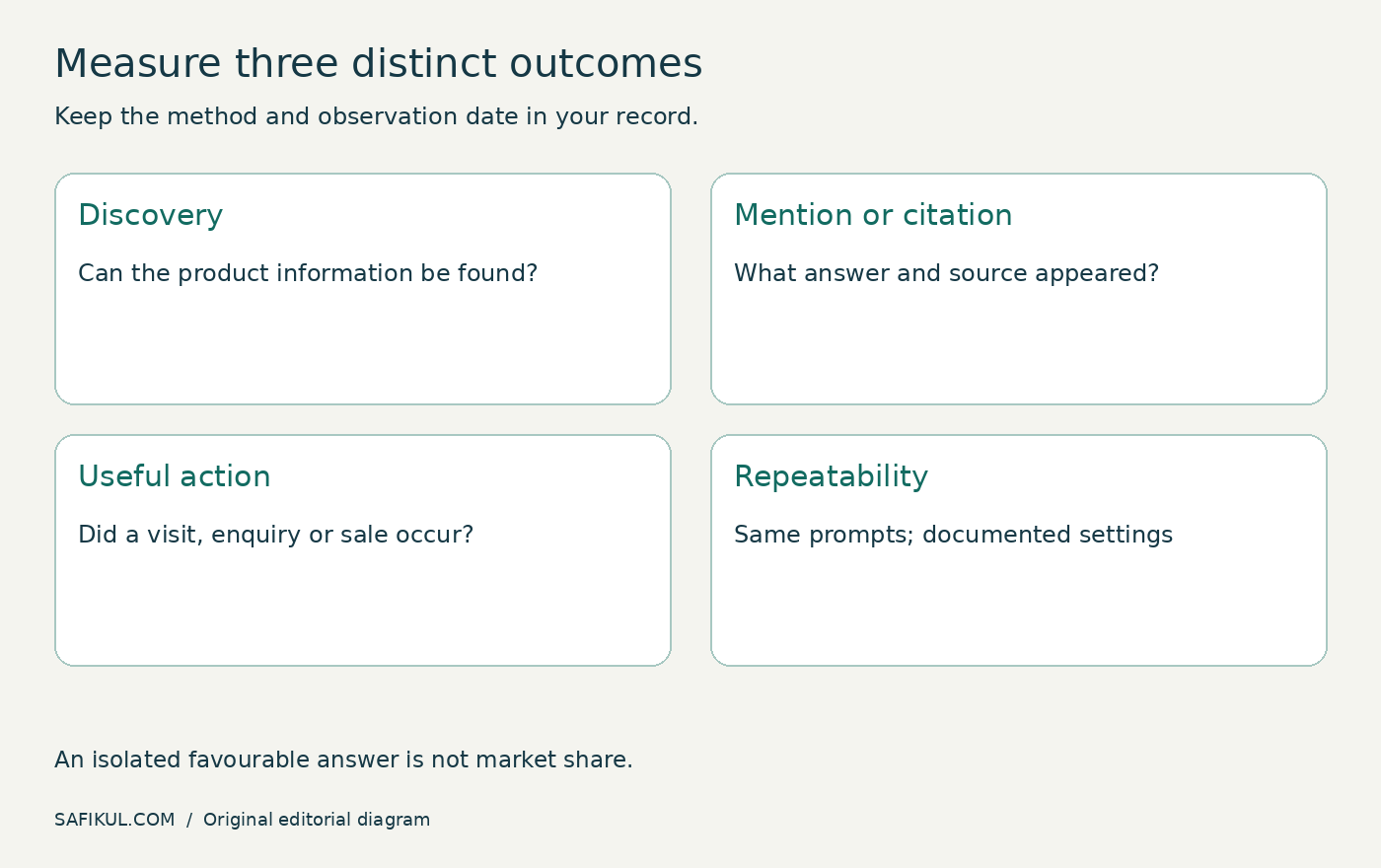
I would track these separately. A screenshot of a favourable answer is a useful observation, not proof of broad market share. Responses can vary with the prompt, location, date and available sources.
1. Build a reliable product information record
Start with ten important products. Record the product name, brand, SKU, legitimate identifiers where applicable, variants, material or specification, price and currency, availability, shipping terms and return conditions. Assign an owner for each field.
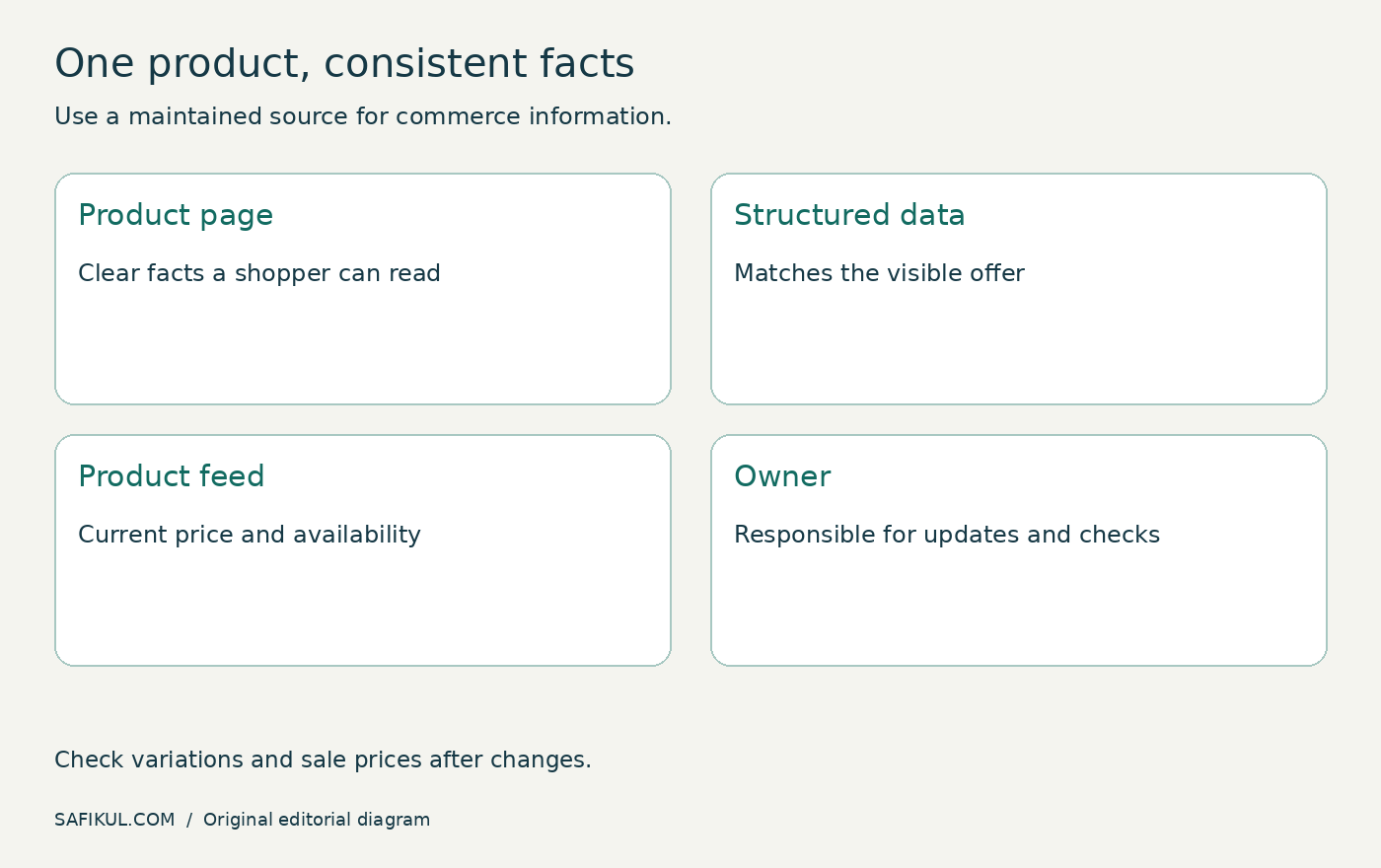
Use the same underlying facts across the visible page, structured data and feed. Do not invent a GTIN, a certification or a review score to make a record look complete. If a field does not apply, investigate the relevant requirements instead of fabricating it.
For a dress, useful details could include fabric composition, lining, size measurements, fit notes, care instructions and whether an accessory is included. “Premium and perfect for everyone” answers none of those questions.
2. Write product copy that supports a buying decision
Put essential information in readable text, not only inside an image. Explain fit and limitations as plainly as benefits. A buyer considering a travel bag needs dimensions and capacity, but also whether it fits the airline or use case they have in mind. Do not claim universal compatibility without evidence.
Here is an illustrative rewrite. Weak copy: “The ultimate bag for every trip.” More useful copy: “A 22-litre day bag with a padded laptop compartment. Check the compartment measurements against your device; it is designed for daily commuting rather than a week of luggage.” The second version helps a reader decide, even if it rules out a sale.
My proposed product-page structure is: a concise description, factual specifications, intended uses, important limitations, variant details, original images, delivery and returns, then questions real customers ask. Adapt the order to the product rather than filling a fixed word count.
3. Keep Google product markup and feeds consistent
Google’s merchant listing documentation explains Product and Offer markup for pages where shoppers can buy. Editorial reviews and merchant product pages have different eligibility requirements. Validate the appropriate implementation rather than copying a review template onto every page.
Google also documents how structured data and Merchant Center feeds can supply product information. These are complementary channels. Neither guarantees a search appearance or AI recommendation.
For a WooCommerce store, first inspect what your existing commerce and SEO plugins already output. Two plugins generating conflicting prices are worse than one maintained implementation. My schema markup guide explains testing and maintenance.
Run a practical consistency check after a sale price or stock change: visible price, selected variation, markup and feed should describe the intended offer. Make sure a default product price is not presented as the price of every variation.
4. Make useful pages discoverable
Link relevant category, product and buying-guide pages. Keep discontinued items and replacements understandable. Avoid creating many near-identical pages targeting slightly different AI queries; they can confuse both shoppers and maintenance teams.
For Google’s AI features, official guidance says established SEO practices remain relevant and no special AI file or schema type is required. Google highlights crawl access, accessible text, internal links and consistent structured data. This is Google-specific guidance, not a promise about every assistant.
Use the SEO best-practices checklist to review access and usability. If variants or filter pages create multiple addresses, review canonical decisions before mass-producing new URLs.
5. Add evidence that deserves to be referenced
Use original product photographs, clear measurements, documented tests where available and genuine customer feedback. Explain how comparisons were made. If you have not tested an item, say what the description is based on rather than presenting a supplier claim as your own experience.
A small retailer can create useful information without an expensive study: a measurement demonstration, a care guide, a comparison of two real variants or an explanation of what a package includes. Check every claim with the person responsible for the product.
Keep the business identity, contact information and policies easy to find. A polished product paragraph does little for trust if the returns policy contradicts the checkout or nobody can explain delivery charges.
6. Measure a small repeatable sample
Create a list of realistic buyer questions by category, use case and constraint. For example: “lightweight commuter bag for a small laptop” is a more useful observation prompt than “tell me our brand is the best.” Record the exact prompt, service, date, location setting where known and the products or sources shown.
Review a consistent sample over time. Count observations, not assumed market share. Separately review referral visits and useful actions in analytics. Missing referral data does not prove there was no influence, but it also does not justify assigning every sale to AI.
My AI visibility measurement guide gives the wider process. Keep internal research notes separate from public marketing claims.
A manageable 30-day implementation plan
- Week 1: inventory ten products, identify contradictory facts and assign data owners.
- Week 2: improve the buying information and original imagery on those pages.
- Week 3: test product markup, feeds, variations and internal links.
- Week 4: repeat the observation sample and review relevant visits, enquiries and sales.
Choose success criteria before editing. A useful early result could be eliminating price discrepancies or making all selected products’ size information complete. Those are observable improvements even before search visibility changes.
Frequently asked questions
Does product schema guarantee AI recommendations?
No. It helps communicate structured facts for supported uses. Recommendation systems make their own selections, and eligibility does not guarantee display.
Should I add an llms.txt file first?
It is not a Google requirement for AI Overviews or AI Mode. I would fix missing product facts and inconsistent offers before experimenting with optional files.
Can a small brand compete without a monitoring tool?
You can improve product information and run a small documented observation process manually. Paid monitoring may save time at scale, but it does not replace product data quality.
Should every product page be long?
No. Include enough information to resolve the purchase decision. Repeated generic paragraphs can obscure the specifications readers actually need.
Start with ten products and make them easier to understand. Accurate facts, useful comparisons and a dependable buying experience are a stronger foundation than chasing a new visibility score without knowing what it measures.