

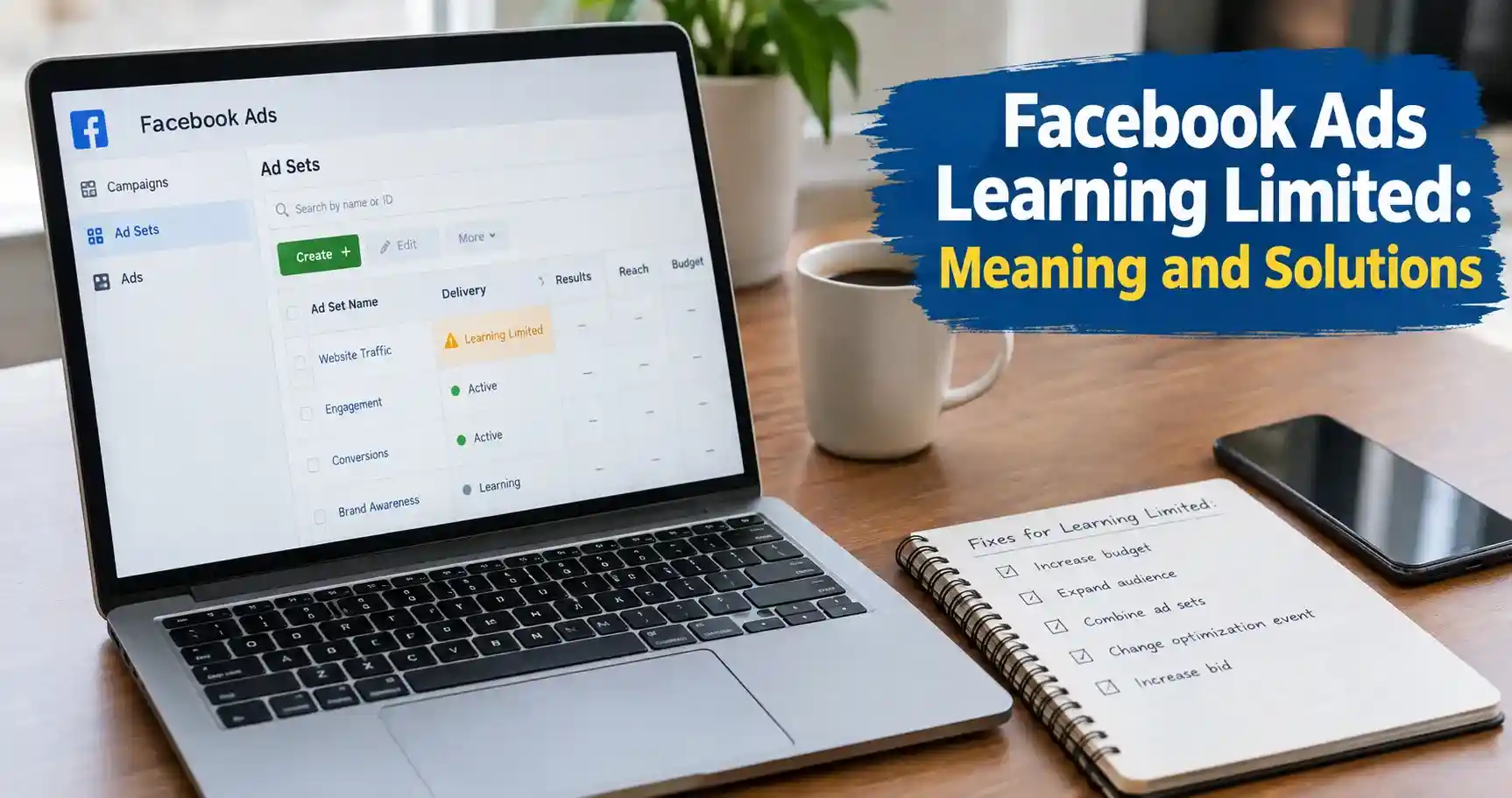
“Learning Limited” means Meta’s delivery system doesn’t expect your ad set to get enough optimization events (roughly 50 in the 7 days after your last significant edit) to properly learn who to show it to. Per Meta’s own help page, it isn’t a penalty. It’s Meta telling you the current setup, budget, audience size, or optimization event, probably can’t generate enough data for the algorithm to optimize delivery efficiently.
That’s the short version. The longer version covers exactly what triggers it, what Meta itself recommends, and a part most guides on this topic skip entirely: a Learning Limited ad set that’s already hitting your targets doesn’t necessarily need fixing at all.
What “Learning Limited” actually means
Every new ad set, and every ad set that’s had a significant edit, goes through a learning phase: a period where Meta’s delivery system tests audiences, placements, and timing before settling into stable delivery. If an ad set gathers enough data- roughly 50 optimization events within 7 days, it moves to Active. If it doesn’t, the Delivery column in Ads Manager shows Learning Limited instead.
Meta’s own definition is worth quoting directly, since it’s more precise than most paraphrases of it: “Learning limited isn’t a penalty, it’s an indication that your budget isn’t being spent effectively because the ad delivery system can’t optimise performance with your current setup.” That one sentence does a lot of work. It’s not a strike against your account, and your ads keep running and keep spending while flagged; it’s a statement about data volume, not ad quality.
Learning, Learning Limited, and Active: how they differ
| Status | What it means | What to do |
| Learning | The ad set is still gathering data and is on track to reach ~50 events in 7 days | Leave it alone; avoid edits that would reset the clock |
| Learning Limited | Meta predicts the ad set won’t reach ~50 events in that window | Diagnose the cause below; a fix is optional, not mandatory |
| Active | The ad set reached the threshold and delivery has stabilized | Normal monitoring; avoid unnecessary edits |
The distinction that matters most: Learning is a temporary state that usually resolves with patience. Learning Limited is Meta’s structural prediction that patience alone won’t fix it, because the setup itself can’t generate enough events.
Why your ad set actually gets flagged
The trigger condition, straight from Meta: an ad set “becomes Learning limited when it is unlikely to receive around 50 optimisation events in the week after your last significant edit.” In practice, that prediction usually comes down to one or more of four things working against each other:
- Budget too low for your cost per result. If your typical cost per purchase is $25 and your daily budget is $30, you’re mathematically capped at roughly one purchase a day, nowhere near 50 a week.
- Audience too small. A narrow interest or custom audience limits how many people Meta can even show the ad to, regardless of budget.
- Optimization event too rare. Optimizing for Purchase when your funnel only produces a handful of purchases a week sets a target the ad set structurally can’t hit, even with decent spend.
- Budget or audience split too thin across ad sets. Five ad sets each getting a fifth of the budget and a fifth of the audience can each individually fall short of 50 events, even if the combined account volume would have been enough in one ad set.
What counts as a “significant edit” (and resets the clock)
This matters because every significant edit restarts the 7-day window. Per Meta’s own definition: “a significant edit is when you pause your ad set or make a change to optimization event, audience or creative. Changes to bid strategy or budget may also be significant, but it depends on the magnitude of the change.” Source: Meta’s “Last Significant Edit” documentation.
The practical implication: tweaking an ad set every day or two to “fix” Learning Limited often makes it worse, not better, since each edit restarts the 7-day clock before the previous attempt had a real chance to accumulate events.
Meta’s own fixes, and the honest version of each one
Meta’s help page lists five troubleshooting options. I’ve kept the official list, but added the caveat each one actually needs in practice:
- Combine ad sets and campaigns. Consolidating similar, competing ad sets into one pools their conversion data instead of splitting it. This is also the direction Meta’s current ad delivery system favors generally, not just a Learning Limited fix.
- Expand your audience. More reachable people means more opportunities to hit the optimization event. Caveat: a broader audience that doesn’t match your actual customer can lower your event rate even as raw audience size grows.
- Raise your budget. If the budget mathematically can’t produce ~50 events at your current cost per result, more budget is the direct fix. Caveat: this only helps if the audience and optimization event are otherwise reachable; raising budget on a fundamentally too-narrow audience just wastes the increase.
- Raise your bid or cost control. A bid set too low to compete in the auction limits how many impressions, and therefore events, you get regardless of total budget.
- Switch to a higher-volume optimization event. Meta’s own example is moving from Purchase to Add to Cart. Caveat: this exits Learning Limited by optimizing for a less valuable action, which is a real tradeoff, not a free fix. A cheaper, easier-to-hit event gets your ad set to Active faster, but Active delivery optimized for add-to-carts isn’t the same as delivery optimized for purchases.
The part most guides skip: it isn’t always something to fix
Here’s the nuance that gets lost when every Learning Limited tag is treated as an emergency: the status describes data volume, not whether your ads are working. A small, profitable local-service account that generates 15 qualifying leads a week, well under the 50-event threshold, will likely sit in Learning Limited more or less permanently. That’s an accurate reflection of its size, not a problem with the ads.
Before applying any of Meta’s five fixes, ask the question that actually matters: is this ad set hitting your cost and volume targets? If yes, consider leaving it alone. Chasing Active status by inflating the budget, broadening the audience past relevance, or switching to a cheaper optimization event can genuinely hurt a Learning Limited ad set that was already doing its job.
A practical diagnostic approach
- 1. Check the Delivery column and confirm the ad set actually reads Learning Limited, not just Learning.
- 2. Check current performance against your actual cost and volume targets before changing anything.
- 3. If performance is on target, consider leaving it; Learning Limited alone isn’t a reason to intervene.
- 4. If performance is below target, work through the math: expected events per week at current budget and cost per result. If that number is far below 50, you have your answer on whether budget, audience, or optimization event is the real constraint.
- 5. Make one change at a time, note the date, and wait out the 7-day window before judging the result. Stacking multiple changes makes it impossible to tell which one worked.
- 6. If several similar ad sets are each individually Learning Limited, test consolidating them before trying anything else.
Common mistakes that make Learning Limited worse
- Editing the ad set every day or two trying to “fix” it, which restarts the 7-day window each time.
- Splitting one audience and budget across many ad sets for testing purposes, then being surprised each one is individually Learning Limited.
- Switching the optimization event to something cheaper without acknowledging that the resulting Active status is now optimizing for a less valuable action.
- Treating Learning Limited as a quality judgment on the ad creative itself, when it’s a data-volume status unrelated to creative quality.
Frequently asked questions
Not inherently. Per Meta’s own documentation, it isn’t a penalty, it’s an indication that delivery may not be fully optimized given the current setup. Your ads keep running. Whether it’s actually a problem depends on whether current performance meets your targets.
Indefinitely, if the underlying cause (low budget relative to cost per result, small audience, or a rare optimization event) doesn’t change. There’s no automatic expiration.
Only if budget is actually the binding constraint. If the audience is too small or the optimization event is too rare for the platform you’re targeting, more budget alone won’t close the gap.
Yes. Meta’s own definition of a significant edit includes changes to creative, along with optimization event and audience changes; budget and bid strategy changes may also count depending on the size of the change, per Meta’s documentation.
Only after weighing the tradeoff. Switching to a cheaper, more frequent event (like Add to Cart instead of Purchase) will likely move the ad set to Active faster, but it changes what the algorithm is actually optimizing for, which may not match your actual business goal.
It’s Meta’s own first recommendation and tends to help when several similar ad sets are splitting one audience and budget. For more on why fewer, broader ad sets generally perform better under Meta’s current delivery system, browse my Facebook Advertising guides, including a companion piece on campaign, ad set, and ad structure.