
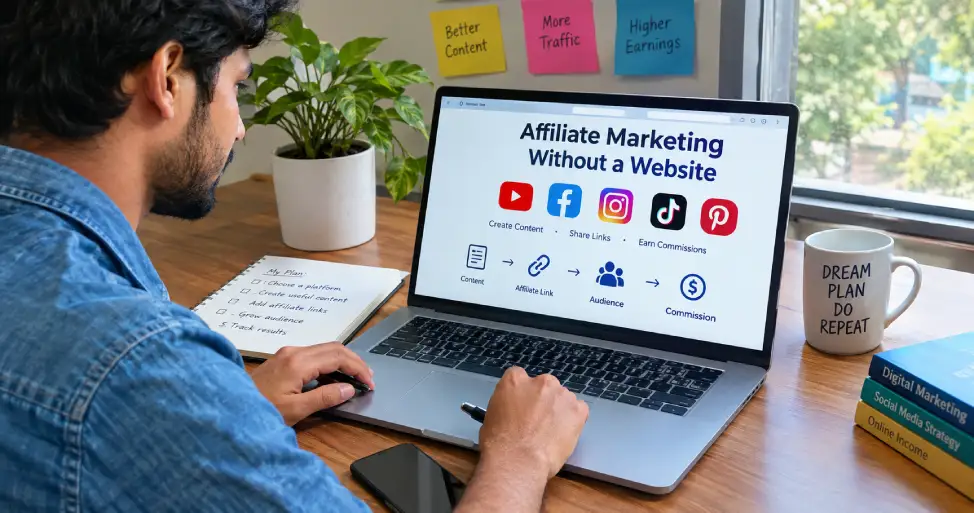
You can start affiliate marketing without a website by publishing useful content on an approved social media profile, YouTube channel or other content platform, then sharing tracked affiliate links. You need a program that accepts your promotional channel, clear disclosures and a practical way to reach people interested in the products.
I already earn affiliate commissions through Facebook, Instagram and YouTube without relying on a dedicated affiliate website. My dashboard screenshots below provide a real example of this approach. A website is optional for some programs, while audience trust and program requirements still matter.
My recommendation is to begin with one channel and one specific buying problem. Help people understand their options, make a relevant recommendation and measure what happens after they click. You can build a website later if the business needs it.
This guide explains how to start affiliate marketing without a website, where links can go, which program requirements to check and how to begin with limited money or no existing followers.
My experience earning affiliate commissions through social media
I use my Facebook page, Instagram profile and YouTube channel for affiliate marketing. These channels let me share product content and earn commissions without making a separate affiliate website the starting point.
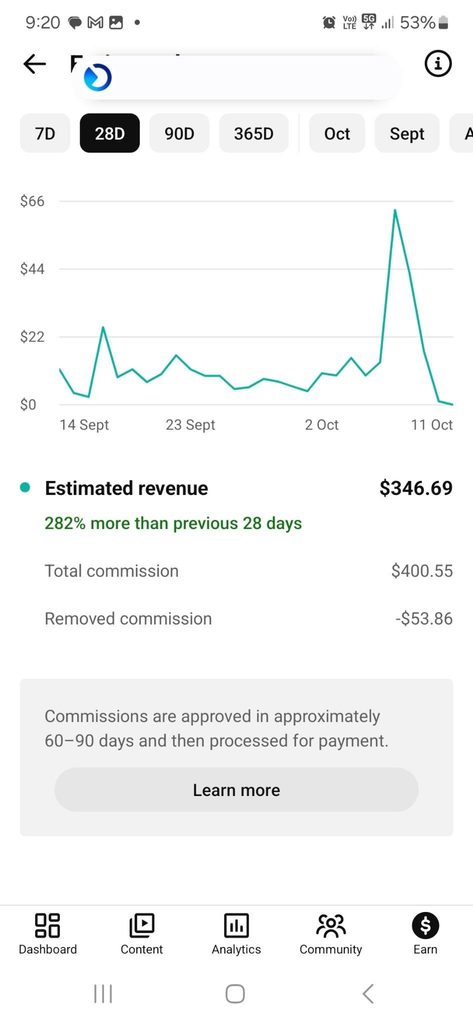
The screenshots I supplied show the following dashboard figures. I have kept each platform separate because the visible metrics and reporting periods are not identical.
| Channel | Figures shown |
|---|---|
| 47,152 total units sold; commissions of $6023.84 | |
| 591 total units sold; commissions of $102.58 | |
| YouTube | Estimated revenue of $346.69 in the selected 28-day view |
Source: My dashboard screenshots supplied on 13 October 2026. The Facebook and Instagram screens mention the last two months for their content-level post lists; that wording does not establish the period covered by the summary totals above them. I have therefore not described those totals as monthly earnings or added a currency symbol.
The YouTube screenshot also illustrates why I separate commission totals from earnings available for payment. It shows $400.55 in total commission and $53.86 removed, leaving $346.69 in estimated revenue. The screen states that commissions are approved in approximately 60 to 90 days before payment processing; that timing belongs to this dashboard, not every affiliate program.
My experience shows that social channels can support affiliate earnings without a dedicated website. These are my own reported results, not a forecast for a new creator. They also do not show my costs or net profit. For a beginner, I would focus first on useful product content, an approved link route and an audience with a reason to trust the recommendation.
What affiliate marketing without a website actually means
You create the recommendation on a platform someone else operates. The merchant handles the product page, checkout and sale. Your approved affiliate link identifies the referral, and an eligible purchase or action may earn you a commission.
For example, you could publish a YouTube tutorial demonstrating a desk lamp and put an approved product link in the video description. You do not need your own online shop or blog to make that referral.
There are three different approaches:
| Approach | Where the audience goes | What you maintain |
|---|---|---|
| Direct linking | From your content to the merchant through an affiliate link | Your publishing account and recommendations |
| A hosted link page | From your profile to a small page of selected links | Your account and the hosted page |
| A creator storefront | From your content to a shopping page supplied by a merchant or platform | Your approved storefront and product selections |
A link-in-bio page or hosted landing page is technically a web page. It can remove the need for a custom domain, hosting setup or full website, but it is not the same as having no intermediate page at all.
If you want affiliate marketing without creating a website of any kind, choose an approved direct-link route.
Choose a method that fits how you create content
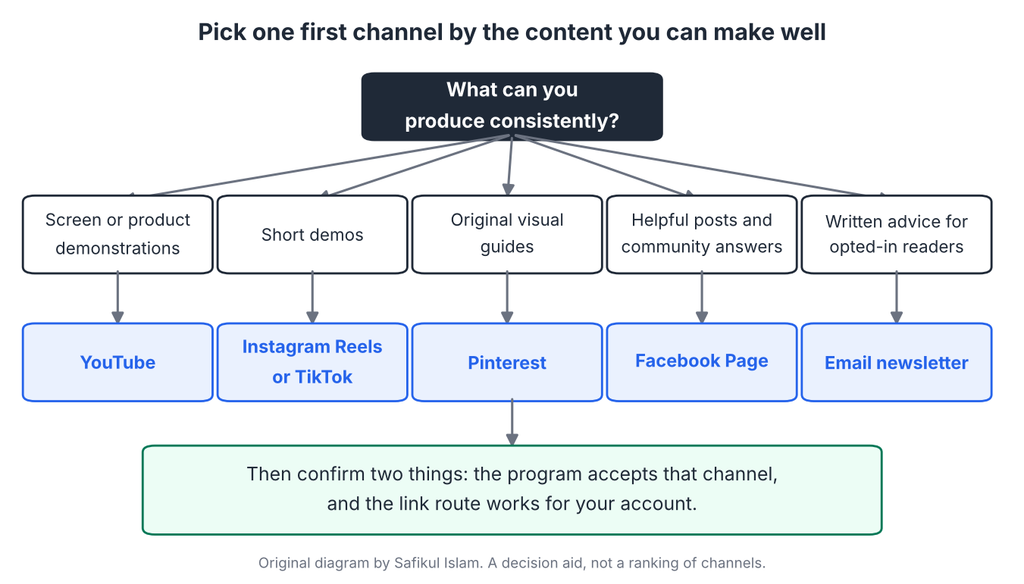
For affiliate marketing without a website for beginners, I suggest choosing by content format and link access first.
| Method | Useful content format | Main condition to check |
|---|---|---|
| YouTube | Tutorials, comparisons and demonstrations | Clickable link access and program approval |
| Helpful posts, product explanations and community discussions | Page or group eligibility and local group rules | |
| Reels, carousels and Stories | Available profile links or Story link stickers | |
| Original visual guides and product-focused Pins | Both Pinterest rules and merchant permission | |
| A useful newsletter for subscribers | Program permission and email-provider policy | |
| TikTok | Short demonstrations and tutorials | Country availability, account features and link eligibility |
If you already have an engaged audience, start there. If you are beginning from zero, choose the format you can produce well and a topic people actively search for. A smaller, focused library of helpful content is easier to improve than six nearly empty accounts.
Six ways to promote affiliate links without a website
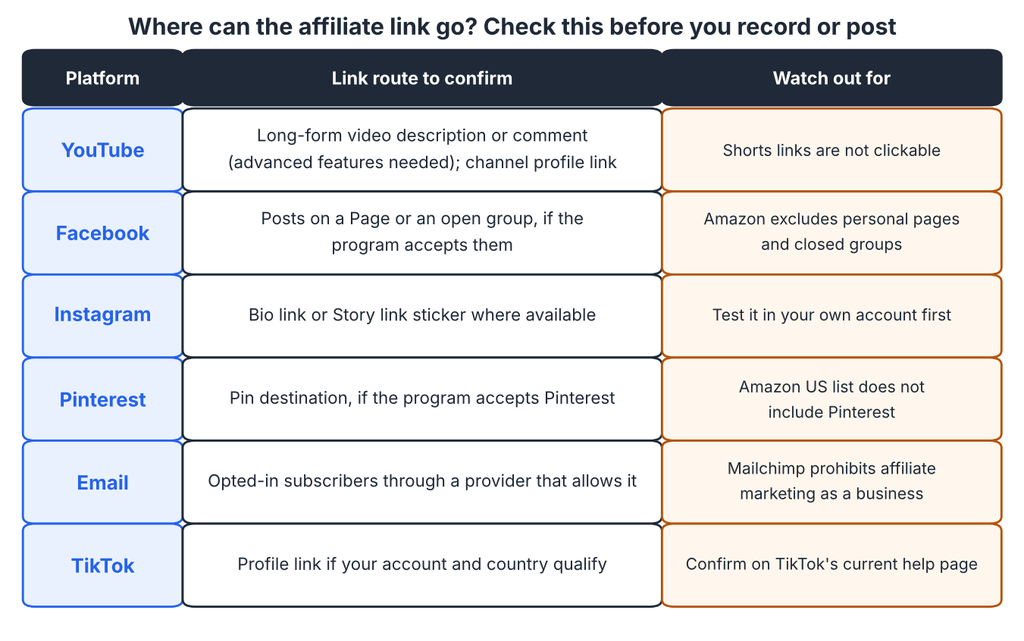
Before you pick a method, look at where each platform lets a link live. This is the question that decides whether a plan works or quietly fails.
1. Use YouTube for tutorials and product demonstrations
Affiliate marketing using YouTube works well when a buyer needs to see something explained: how software works, whether a tool fits a task or how two products differ.
Build each video around a specific question. For a home-office audience, that might be “How to check whether a monitor arm fits your desk.” Explain measurements, installation limits and alternatives before recommending a product.
YouTube’s link-sharing guidance distinguishes between clickable surfaces. External links in long-form video descriptions and comments require advanced-feature access. URLs in Shorts descriptions and Shorts comments are not clickable; channel profile links provide another route.
Before recording a call to action, check where viewers can actually tap. A Short can direct people to a relevant channel profile link, or to a related video where that feature is available. Do not tell viewers to click a description link that functions only as text.
For a long-form video, place the relevant approved link near a clear description of the product and disclose the relationship in the video and beside the link. Check the destination on mobile after publishing.
Ordinary merchant affiliate links and YouTube’s own Shopping affiliate program are separate arrangements. Eligibility for one does not automatically qualify you for the other.
2. Use a Facebook page or a suitable Facebook group
Affiliate marketing using Facebook can begin with a page that helps a defined audience. Publish buying checklists, short demonstrations and answers to recurring questions.
For example, a page about small-space gardening could explain how to select a planter with drainage. A product recommendation belongs after that explanation, with a visible disclosure and a permitted link.
A Facebook group can support deeper discussion, but check two sets of conditions: the group’s promotion rules and your affiliate program’s rules. Administrator permission alone does not establish merchant permission.
Amazon’s US application guidance accepts Facebook fan pages and open group pages, but excludes personal pages and closed groups. Other programs may assess Facebook differently.
I would build a page around repeatable advice, then use a group only if there is a clear community purpose and time to moderate it. Posting the same offer across unrelated groups is unlikely to build useful relationships.
For the wider work of content planning and audience engagement, explore my social media marketing guides.
3. Use Instagram with a clear path from content to link
Affiliate marketing using Instagram needs more than a product photograph. Show the detail that helps someone decide: size, compatibility, setup, appearance in use or a meaningful limitation.
Use the link options available in your Instagram bio or a Story link sticker where available. Your content should identify the destination clearly, such as “The compact stand shown here is linked on my profile.” Test the route in your own account instead of assuming that a pasted caption URL gives every viewer a clickable path.
A simple content sequence could include a Reel explaining the problem, a carousel comparing purchase criteria and a Story answering a common question. Each piece should be useful independently.
Meta’s branded-content guidance is the page I would start from for branded-content rules, but Meta’s help pages change and I could not reopen it to confirm the wording on 13 October 2026. Check Instagram’s current rules inside your own account, use the paid partnership label wherever it applies to your post, and add a plain-language explanation of the commission relationship either way.
If you use a link-in-bio page, keep it focused. A visitor who watched a desk-stand demonstration should not need to search through twenty unrelated buttons to find it.
4. Use Pinterest for useful visual recommendations
Affiliate marketing using Pinterest can work without a blog when the affiliate program permits direct links from Pinterest.
Create an original Pin that answers a practical need, such as a compact desk layout or a checklist for choosing a travel organizer. Use a relevant title, a clear description and an honest explanation of the linked destination.
Pinterest’s affiliate guidelines require original value, commercial transparency and compliance with its broader rules. They also warn against repetitive, high-volume affiliate posting. Some shortening services are unsupported, so do not conceal or repeatedly modify a blocked destination to get around restrictions.
Pinterest permission does not establish merchant permission. Amazon’s US social-network application list does not currently include Pinterest, so do not assume a Pinterest-only application qualifies.
My recommendation is to choose a program that explicitly accepts your Pinterest activity, then build a small collection of useful, distinct Pins. Use images you own or are authorized to use.
5. Build an email newsletter with permitted recommendations
Affiliate marketing using email can operate through a hosted signup form and newsletter service. You do not need a full blog, but you do need subscribers who chose to hear from you and a provider that permits your business model.
Use a clear subscription promise, such as a weekly guide to affordable home-office equipment. Share practical advice and include a recommendation only when it fits the topic. Keep unsubscribe options and required sender information in place.
Check both sides before sending:
- Does the affiliate agreement allow this type of email promotion?
- Does the email service allow your proposed content and business model?
These rules can differ sharply. Mailchimp’s policy distinguishes occasional permitted affiliate links from affiliate marketing as a prohibited business category. Do not assume every newsletter tool is suitable for a promotion-led affiliate business.
Also avoid repeating outdated universal rules. The current Amazon US participation requirements permit Special Links in certain opted-in emails, SMS, and social direct messages, subject to the agreement and other conditions. Check the agreement for your country and communication method; this is not permission to send unsolicited links.
Begin with a useful newsletter people want to receive. A collected list of strangers’ addresses is not an audience-building strategy.
6. Use TikTok where it is available and suitable
TikTok videos can demonstrate a product quickly, but confirm platform availability in your country and your account’s link features before choosing it as your main channel.
TikTok’s profile-link guidance is the page to check for current link eligibility. I could not retrieve its text on 13 October 2026, so confirm it yourself instead of relying on a third-party summary. An ordinary new account should not assume it can immediately add a clickable external affiliate link.
Create a complete demonstration even when the video is short. Show the task, explain the result and identify a drawback or limitation that matters to the buyer. Then use an available, permitted link route with a visible disclosure.
TikTok Shop affiliate participation is a separate program with its own market and account requirements. Promoting an external merchant and tagging a product through TikTok Shop should not be presented as the same setup.
If the necessary features are unavailable, choose another accessible channel. Do not build a strategy around bypassing regional or account restrictions.
Affiliate programs without a website that you can investigate
Some programs and networks accept social publishers, but none of the options below means automatic approval for an empty account.
| Option | Evidence of a website-free route | What to verify |
|---|---|---|
| Amazon Associates US | Its application guidance accepts specified public social accounts | Accepted account type, content, followers and application review conditions |
| Awin | Its FAQ accepts social channels, email newsletters and other digital formats | Network approval, any signup deposit and each advertiser’s separate terms |
| eBay Partner Network | eBay lists social network pages among promotional channels | Account acceptance, program terms and permitted promotional methods |
Amazon’s US application review page describes established public social accounts with substantial organic followers, usually at least 500. It also requires three qualifying sales within the first 180 days for review; personal orders do not count. The same page lists the social networks it accepts for applications: Facebook, Instagram, Twitter, YouTube, TikTok and Twitch.tv. Check the complete page before applying.
Awin’s FAQ explicitly supports participation without a traditional website. Network acceptance and acceptance into an advertiser’s program are separate steps. The FAQ also mentions a $1 deposit at signup, so read the refund terms shown in your regional signup flow rather than assuming enrollment has no cash requirement.
eBay’s Partner Network overview includes promotion through social network pages. Some methods, including electronic communications, require additional approval under its special business model guidance.
Read the offer that applies to your country and intended channel. Check audience location, eligible products, commission, attribution, payment threshold and restrictions before investing heavily in content.
My Target affiliate program guide shows how to examine another individual program’s details. It is a program review, not a promise that Target will accept every website-free applicant.
How to start in seven practical steps
Step 1: Choose one audience and a narrow buying problem
Write down who you help and what they are trying to choose. “Equipment for people recording tutorials at a small desk” gives you clearer ideas than “technology products.”
Select a topic you can explain accurately. Consider what you already use, what you can demonstrate and whether suitable products are available to your audience.
Step 2: Choose your content platform and link route
Pick one primary channel. Confirm whether the link will go in a description, profile, Story, Pin or permitted newsletter.
Map the complete journey before making content: viewer sees recommendation, understands the commercial relationship, finds the correct link and reaches the relevant product. Remove any unnecessary steps.
Step 3: Prepare a credible public profile
Use a clear name, explain your subject and publish original content that demonstrates your approach. Keep the profile accessible if the program needs to review it.
I suggest creating several useful posts before applying. The exact number is your planning choice unless a program specifies a requirement. An account filled entirely with sales links gives a reviewer little evidence of your value to an audience.
Step 4: Apply honestly and confirm approval
Submit the exact URL of your social media profile or YouTube channel, rather than the platform homepage. Describe your topic, audience and intended promotional methods accurately.
If an application asks for a website, check whether it accepts a social URL or offers a creator application. Ask the program manager if the route is unclear. Do not enter a fabricated website or someone else’s property.
Wait for the permission required by that program before promoting under its affiliate arrangement.
Step 5: Create a helpful first recommendation
Use a simple structure: the reader’s problem, the buying criteria, what the product offers, who it suits and when an alternative is better.
For a desk accessory, explain dimensions and compatibility. For software, show a task using an account you are entitled to access. Separate firsthand observations from information you researched.
Your content should help someone decide even if they choose not to buy.
Step 6: Disclose the relationship and test the link
An understandable example is: “Ad — I may earn a commission if you buy through this link.”
Place the disclosure with the recommendation. In video, make the relationship clear within the video as well as near the written link; use readable on-screen wording and spoken disclosure where appropriate. For Stories, keep the wording visible long enough to read.
The FTC’s social media disclosure guidance explains why a disclosure hidden on a profile or behind a “more” click can be missed. Platform labels do not remove your responsibility to explain the relationship clearly.
For content aimed at Indian audiences, also review ASCI’s influencer guidance, including visible labels and disclosures in an appropriate language. Program-specific wording may be required in addition to your explanation.
Test the published route on mobile. Check that the destination is correct and the approved tracking information remains intact. Do not make self-purchases as a tracking test unless the program expressly allows them.
Step 7: Track approved results and improve the content
Use the affiliate dashboard and your platform’s analytics. A website analytics installation is not necessary to begin recording referral performance.
Where supported, create program-approved tracking IDs or sub-IDs for different content pieces. A shortener’s click count alone cannot confirm whether a purchase earned commission.
Keep a small record of content, publish date, views, outbound clicks, reported conversions, approved commission and cash paid. Pending commissions can change after returns or validation.
Review the weak point: no reach may call for a better topic; views without clicks may indicate an unclear recommendation; clicks without sales may reflect product fit, pricing, destination or attribution. Work on one issue at a time.
Ways to start with limited resources
Affiliate marketing without followers
You can start publishing with zero followers, but you cannot assume immediate affiliate approval or earnings. Some programs expect an established audience, and a new account may lack useful link features.
Choose questions that people search for, such as compatibility checks or setup problems. Publish clear answers, respond to relevant comments and improve the content that attracts interested viewers. Apply when your account meets the chosen program’s requirements.
Avoid buying followers. A larger displayed count does not establish trust or purchase intent.
Affiliate marketing without showing your face
You can use screen recordings, overhead demonstrations, your own product photographs, narrated slides or close-up comparisons.
For example, a creator can explain a spreadsheet tool through a screen recording without appearing on camera. Show the actual task and result, and remove private information before publishing.
Being faceless does not mean being unaccountable. Keep your recommendations honest and your disclosures visible. Do not use stock footage or generated visuals to imply that you personally tested a product.
Affiliate marketing with no money
Free affiliate marketing methods include organic posts, videos made with existing equipment and permitted direct links. You can avoid a domain, hosting and paid advertising at the beginning.
There are still costs in time, connectivity and product access. Some programs or tools have fees, deposits or limits. Use products you already understand and check the relevant signup terms before calling a method completely free.
My starting recommendation is to spend only where it improves the quality of the explanation. Expensive software does not resolve an unclear audience or a weak recommendation.
Do you need a landing page for affiliate marketing
No, if your approved platform placement can link directly to the merchant. A landing page for affiliate marketing becomes useful when people need context, several relevant choices or a newsletter signup option.
Keep a hosted page simple: identify yourself, explain the topic, disclose the commercial relationship and label the links clearly. Check whether the affiliate program requires you to register that page as a promotional property.
A link-in-bio page organizes destinations; it does not generate demand by itself. It can also introduce an extra click. Use one when it solves a real navigation problem, rather than adding it automatically.
A creator storefront has the same limitation: the merchant may provide the page, but you still need approval and a reason for people to visit it.
A realistic example of a website-free campaign
Imagine a creator publishing a tutorial about choosing a compact desk lamp. They use their own footage, explain who the lamp suits and share an approved affiliate link through an available placement.
Suppose the content generates 2,000 views, 80 affiliate clicks and two approved sales. At an illustrative $5 commission per sale, that produces $10 in approved earnings.
The click rate is 80 ÷ 2,000 = 4%. Approved earnings per click are $10 ÷ 80 = $0.125. These figures are teaching assumptions, not expected results or industry benchmarks.
If the creator spent $25 producing that content, the example has not recovered its cash cost. If a payment threshold applies, the approved balance may not yet be payable.
This is why I would learn with organic content before buying traffic. Views, commissions and profit answer different questions.
Common problems and what to change
| Problem | Practical next step |
|---|---|
| My application was rejected | Read the reason and improve the actual eligibility gap before reapplying |
| People cannot click the link | Check the specific placement and account feature requirements |
| The platform blocks my destination | Review the destination and policies instead of hiding it behind another redirect |
| My posts receive views but no clicks | Make the product relevance and next step clearer |
| Clicks produce no approved sales | Check audience fit, destination, exclusions and tracking reports |
| My commissions remain unpaid | Review approval status, threshold, payment schedule and account details |
Forums, other people’s comments and groups are not universal free advertising spaces. Participate where you can contribute, and post commercial links only when both the community and program allow them.
If you are asking where to post affiliate links for free, start with places you control and the program has approved: your own public profile, Page, channel or an opted-in newsletter. Treat every other place as off limits until its own rules and your program’s rules both allow commercial links.
Paid direct linking also needs separate checks. A merchant accepting organic social referrals does not automatically permit search ads, brand bidding or paid social promotion. I would leave those methods until the rules and economics are understood.
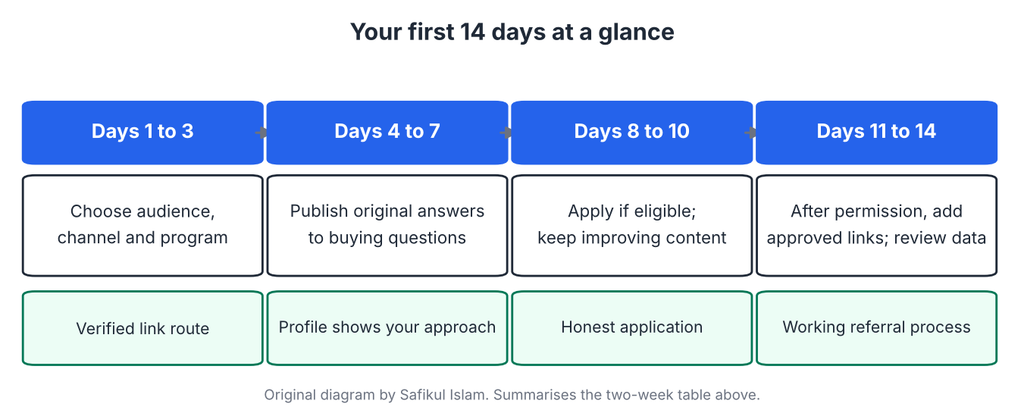
A simple two-week starting plan
| Period | Main action | Useful outcome |
|---|---|---|
| Days 1 to 3 | Choose one audience, channel and potential program | A clear topic and verified link route |
| Days 4 to 7 | Create original answers to several buying questions | A profile that demonstrates your approach |
| Days 8 to 10 | Apply if eligible and refine content while waiting | An honest application and useful content library |
| Days 11 to 14 | After permission, add approved links and review available data | A working referral process and a list of improvements |
This is a suggested schedule, not an approval or income deadline. If you have not reached a program’s requirements, continue audience building rather than forcing the application.
Frequently asked questions
Yes, when a program accepts your social account or other promotional channel. You still need to meet its requirements, produce useful content and follow disclosure and platform rules.
Yes. Video demonstrations, social posts, Pinterest Pins and permitted email newsletters can support affiliate marketing without a blog. Choose the method that fits your audience and the program’s approved traffic sources.
Potential placements include approved Facebook posts, eligible YouTube descriptions, Instagram profile links or Story stickers, Pinterest Pins and permitted newsletters. Availability, program permission and account eligibility differ. “Free to post” does not mean every affiliate link is allowed.
Amazon Associates US accepts certain public social accounts subject to its application requirements. An empty account or any arbitrary platform is not enough. Review the current rules for the Amazon marketplace you plan to use.
I would start with one channel you can use confidently. YouTube suits detailed demonstrations, Instagram suits visual explanations, and Pinterest suits original visual guides. Existing audience interest, link access and program eligibility should decide the choice.
A website may help when you need longer comparisons, organized resources and more control over your publishing. Social platforms can change features or restrict accounts, so keep copies of your original content and records of your partnerships. Begin without a website if that helps you publish now, then add one when you have a clear purpose and the capacity to maintain it.
Start with one helpful recommendation and a working link route. Improve those before expanding to more platforms. You can explore my affiliate marketing guides as you compare programs and plan your next step.
Screenshots supporting my social affiliate case study
Facebook, Instagram and YouTube dashboards, shown from left to right. Source: Safikul Islam, supplied 13 October 2026. The screenshots are reproduced as supplied; the figures are transcribed in the case-study table.
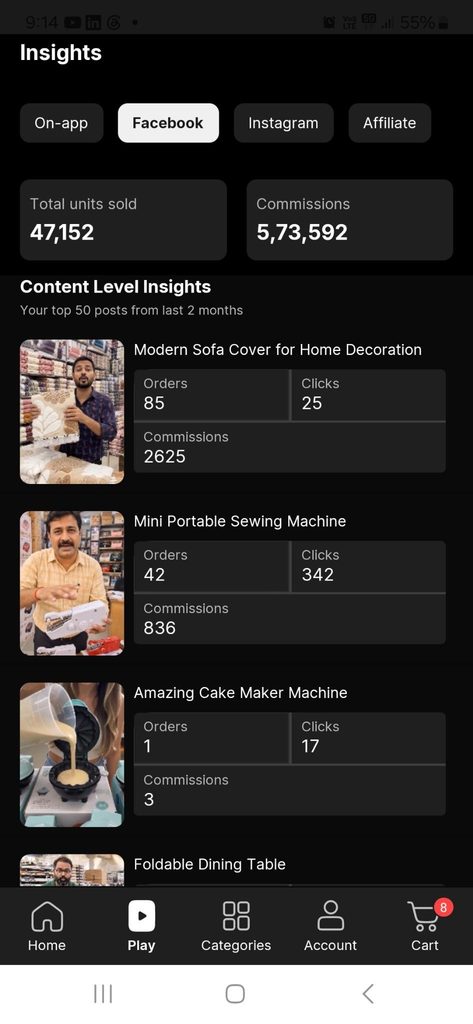
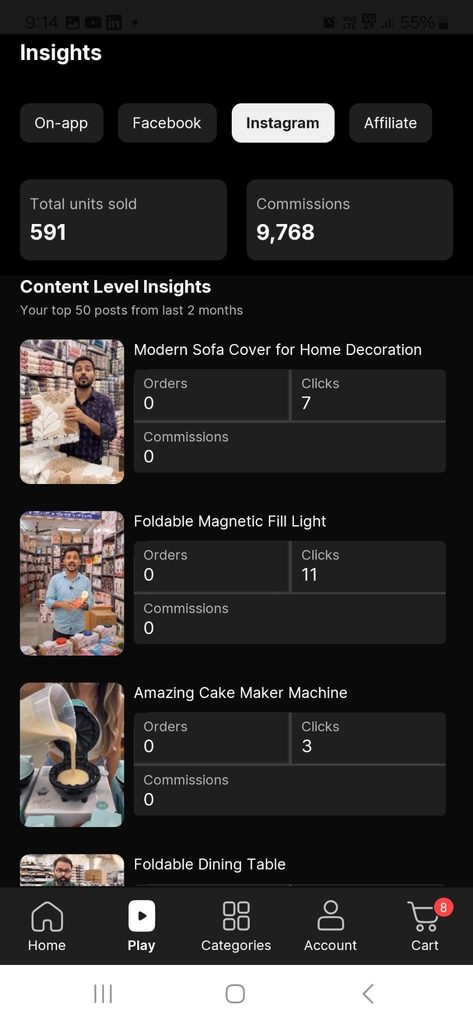
Facebook and Instagram: Dashboard commission figures, not verified withdrawals. The content-level two-month label does not establish the summary period.
YouTube: Selected 28-day view. Estimated revenue can differ from final payment. Do not combine these three screenshots into a single monthly earnings claim.