

The Target affiliate program lets approved publishers earn commissions by referring shoppers through tracked links. Applications are free, and the official Target Partners website advertises earnings of up to 8% on qualifying purchases. The rate that matters for your business, however, is the rate attached to the products you actually recommend.
My approach to affiliate marketing is straightforward: start with your audience, understand the numbers, and then choose the program. A familiar retail name can help a reader feel comfortable buying, but it cannot make an unsuitable product recommendation useful.
This guide explains where to apply, how commissions work, where to sign in, and what to check before investing time in content. It also separates Target Partners from Target’s newer creator initiatives, which are easy to confuse.
Target affiliate program at a glance
| Question | Short answer | Where to verify |
|---|---|---|
| What is the program called? | Target Partners is the publisher affiliate route covered here. | Official Target Partners website |
| Is applying free? | Yes. Acceptance is a separate decision. | Official application and FAQ |
| What is the advertised commission? | Up to 8% on qualifying purchases. | Homepage and your approved contract |
| What is the referral window? | The public FAQ describes a seven-day cookie with last-click attribution. | Target Partners FAQ |
| Which platform supports tracking? | impact.com. | Target Partners and program manager listing |
| Where do I begin? | Visit partners.target.com and select Apply Now. | Official homepage |
Start with the official Target Partners website and keep the program FAQ available while reviewing your options.
How the Target affiliate program works
The basic business model connects three things: useful content, a tracked referral and an eligible purchase. You help someone make a buying decision, they follow your affiliate link, and the program determines whether the resulting transaction earns a commission.
Acceleration Partners’ Target listing identifies impact.com as the network and describes the program as cost per acquisition. In practical terms, sending traffic alone is not the same as earning revenue.
For a blogger, the opportunity might be a detailed buying guide. For a specialist publisher, it might be a product comparison. The strongest starting point is a question your readers already ask, followed by products that genuinely help answer it.
I would ask one question before applying: would I still recommend these products if there were no commission? If the answer is no, the content needs a different direction.
Target Partners vs Club Target vs Target Ambassadors
These names do not describe one interchangeable application or commission system.
| Program | Main purpose | Practical distinction |
|---|---|---|
| Target Partners | Affiliate referrals through tracked links | The publisher program discussed in this guide |
| Club Target | A community for everyday and emerging creators | Challenges, rewards and opportunities to earn commissions |
| Target Ambassadors | A program for established creators, powered by LTK | Commission opportunities alongside campaigns and other eligible incentives |
Target introduced Club Target and its updated ambassador approach in its May 2026 creator announcement. Do not transfer eligibility requirements, reward levels or tracking rules from one program to another.
One concrete difference to know about: Club Target’s own signup page states that applicants must be based in the US, be at least 18, and have a public profile with 500 or more followers on Instagram and/or TikTok. Its program terms describe participation through a separate platform provider, Duel, rather than the impact.com tracking used by Target Partners. For readers outside the US, that means Club Target is not an easy fallback if the Partners eligibility question above stays unresolved.
If you mainly publish shopping articles, begin by evaluating Target Partners. If your work centers on social content and brand collaborations, review the creator options separately.
Target affiliate program sign up
For Target affiliate program sign up, use the official website rather than a third-party registration service.
1. Prepare a clear publisher profile
Before opening the application, gather your website or publishing channel details, a short description of your audience and an explanation of your content approach.
I suggest preparing three examples that show how you help readers choose products. These are my application preparation recommendations, not a published three-article requirement.
Useful examples could include a buying checklist, a comparison that explains trade-offs, or a tutorial showing how a product solves a specific problem. Avoid presenting an unfinished site as an established publication.
2. Open the official application
Visit Target Partners and select Apply Now. The homepage also has a Partners menu with an Apply now option. Follow the application flow linked there and provide accurate information when requested.
An existing network account should not be treated as proof of acceptance into Target’s program. Check your Target partnership status before assuming you can start earning.
3. Review the agreement before submitting
Read the Target affiliate terms and the terms presented during enrollment. Approval is discretionary, and your contract contains the applicable commission details and exclusions.
Make a private checklist of the points you need clarified: eligible products, approved publishing properties, permitted promotion methods and payment timing. Resolve uncertainties before building a campaign around them.
4. Confirm approval and set up tracking
After acceptance, use the link tools made available through your approved account. Check that a link opens the intended destination and retain any tracking parameters the platform supplies.
Keep a simple record of the article, destination product and date added. That record becomes valuable when an item sells out, changes price or stops fitting the recommendation.
Is the Target affiliate program sign up free
Yes. Target describes joining as free. You do not need to buy a course or pay an intermediary to reach the official application.
Free enrollment does not make content production cost-free. Hosting, photography, research and your own time still belong in your business calculation.
Who can apply and what about applicants outside the US
The public FAQ describes family-friendly publishers serving mainly US audiences. It also says overseas applicants may qualify where impact.com supports their country and their content targets US shoppers.
However, the public agreement includes a US-based eligibility restriction. These pages are not fully aligned. Applicants in India or another non-US country should request written clarification from targetpartners@target.com before relying on eligibility.
For my international readers, this is a practical planning issue. Do not spend weeks creating a dedicated content section until you know whether your business location and publishing setup are acceptable.
Target affiliate program commission explained
The advertised Target affiliate program commission is up to 8%, not a promise that every order earns 8%. Acceleration Partners publicly lists a 1%–8% range, while the program agreement directs publishers to their contract for the applicable details.
I would not build a revenue forecast from an old category-rate table copied across blogs. A table can look precise while describing terms that no longer apply to your account.
Before choosing products, answer these questions using your current offer:
- Does this product or category earn commission?
- What rate applies to my partnership?
- Are there exclusions or special campaign conditions?
- What happens if the shopper returns or cancels the order?
- When does a reported transaction become payable?
A realistic earnings example
Here is a hypothetical calculation, not a Target earnings forecast.
Assume your content generates $2,000 in eligible, credited sales. Applying different illustrative rates produces these results:
| Eligible sales | Illustrative rate | Calculated commission |
|---|---|---|
| $2,000 | 1% | $20 |
| $2,000 | 5% | $100 |
| $2,000 | 8% | $160 |
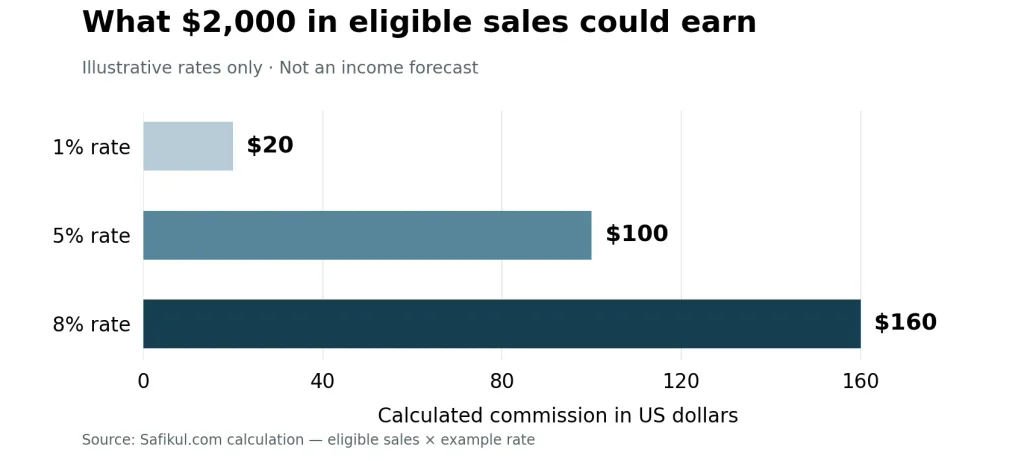
The formula is simple: eligible credited sales multiplied by the applicable commission rate. The difficult work is attracting the right reader, helping them choose and keeping the recommendation accurate.
One more benchmark worth using: Target’s own program FAQ states an estimated earnings per 100 clicks (EPC) of approximately $3 to $4. That is an average published by the program, not a promise for your content, and your result will move with your audience and product mix. At that estimate, 1,000 outbound clicks would be worth roughly $30 to $40 in commission.
Some third-party guides quote a much higher figure; Tapfiliate’s guide cites roughly $12 to $13 per 100 clicks. I could not match that number to anything on Target’s own pages, so I would plan around the official $3 to $4 range and replace it with your own finalized numbers after a small pilot.
I would also calculate net return after content costs. A page that earns $100 but costs $300 to produce needs a longer useful life, lower maintenance costs or a stronger reason to exist.
How the seven-day referral window works
The Target Partners FAQ describes a seven-day cookie and last-click attribution. A later qualifying affiliate click can affect who receives credit. The FAQ also says qualifying repeat orders within the window can count.
For example, a reader might click your link on Monday and buy on Wednesday. That timing falls within seven days, but timing alone does not prove that the sale will be credited to you. Product eligibility, attribution and transaction validation still matter.
Treat the referral window as one part of tracking, rather than a guarantee attached to every visitor.
How payments move from reported sales to cash
A dashboard showing a commission does not always mean the money is ready to withdraw.
Impact.com’s payment guide describes stages including pending actions, locking, clearing and payment checks. Transactions can be reversed before they lock, for example when a purchase is returned. Withdrawal also depends on account requirements and your payment settings.
Check the schedule in your Target contract, complete the required payment information and distinguish pending earnings from available funds. Avoid assuming that a platform-wide withdrawal setting is Target’s own payment promise.
For business planning, keep three separate figures: reported commission, finalized commission and money actually received. That separation makes a monthly performance review much more useful.
Target affiliate program sign in
For Target affiliate program sign in, open partners.target.com, select Partners in the navigation and choose Sign in. Start from this official route instead of a saved search advertisement or an unfamiliar login page.
Use the credentials associated with your publisher account. Your ordinary Target shopping login is not evidence of an approved affiliate partnership.
If you cannot find your partnership after signing in, check which email address you used, review your application messages and verify that you are in the correct publisher account. Contact program support if your status remains unclear.
Do not send passwords or verification codes to anyone offering to activate your account.
Rules to check before promoting Target products
The program agreement restricts branded SEO and paid-search tactics, sets disclosure requirements and limits reuse of Target assets. Review those sections before publishing affiliate promotions; ordinary SEO advice is not a substitute for program permission.
For disclosures, the FTC’s endorsement guidance emphasizes making the commercial relationship clear and noticeable. A statement hidden in a footer does not adequately explain a paid recommendation near the top of a page.
Once accepted, an explanatory disclosure might read: “I participate in Target’s affiliate program and earn a commission when you purchase through my links.” Adapt it to the applicable agreement and content format. Do not claim participation before you are approved.
My broader advice is to make the reader’s decision easier. Explain why you recommend an item, identify its limitations and distinguish your own testing from research based on specifications.
My practical content strategy for this program
A useful affiliate page should contain enough information to help someone decide before they leave your website.
Choose one audience problem
Instead of publishing a broad collection of unrelated products, focus on a need such as organizing a small workspace or choosing storage for a rented apartment.
The question gives the page a purpose. It also helps you decide which features matter and which products do not belong.
Add information shoppers can use
For a storage comparison, consider dimensions, capacity, assembly, materials and suitability for the available space. Explain when the cheapest option is sufficient and when spending more solves a real problem.
If you have not used a product, say what your assessment is based on. Never turn a manufacturer’s description into a fictional personal review.
Plan a maintainable publishing schedule
I would start with one substantial guide and a few supporting articles, then improve them using reader questions and performance data. Fifty weak product roundups create fifty maintenance problems.
For the planning process, explore my content marketing guides. The aim is to connect a clear audience need with content you can keep useful over time.
Measure qualified traffic and actual returns
Track page visits, outbound affiliate clicks, credited orders, finalized commission and production costs. Keep the measurement period consistent when comparing pages.
A useful metric is finalized commission divided by outbound affiliate clicks. Label whether you are showing earnings per click or per 100 clicks; mixing those units can make a small result look much larger.
Review the program as part of your wider affiliate marketing strategy, rather than making your whole business dependent on one retailer.
Frequently asked questions
The official Target Partners website had an application entry point when checked on September 28, 2026. Do not assume changes to a separately named creator initiative mean the publisher program has ended.
No. The public headline is a maximum. Verify the applicable rate and eligibility in your offer before recommending products on the assumption that they earn commission.
Do not assume a social-only profile qualifies for the publisher route. Ask the program team whether your publishing setup is acceptable, and consider the separate creator options if social content is your main activity.
The sources reviewed do not establish a reliable approval deadline for every applicant. Use the status and instructions supplied with your application instead of treating a third-party estimate as a guarantee.
No reliable income forecast follows from joining alone. Audience fit, eligible products, conversion, attribution, commission rates and content costs all affect the result.
My affiliate marketing experience on Facebook and YouTube
In my own affiliate work, I have generated $2,500+ per month through promotions on Facebook and $200+ per month through YouTube. These are my reported results from other affiliate activity, not earnings from Target Partners. I share them as background to my perspective on affiliate marketing, rather than as a forecast of what another publisher will earn.
My publishing channels include my Facebook page, my YouTube channel and Instagram @esafikulislam. The earnings figures above refer to Facebook and YouTube; I am not making an Instagram earnings claim here.
What my earnings screenshots show
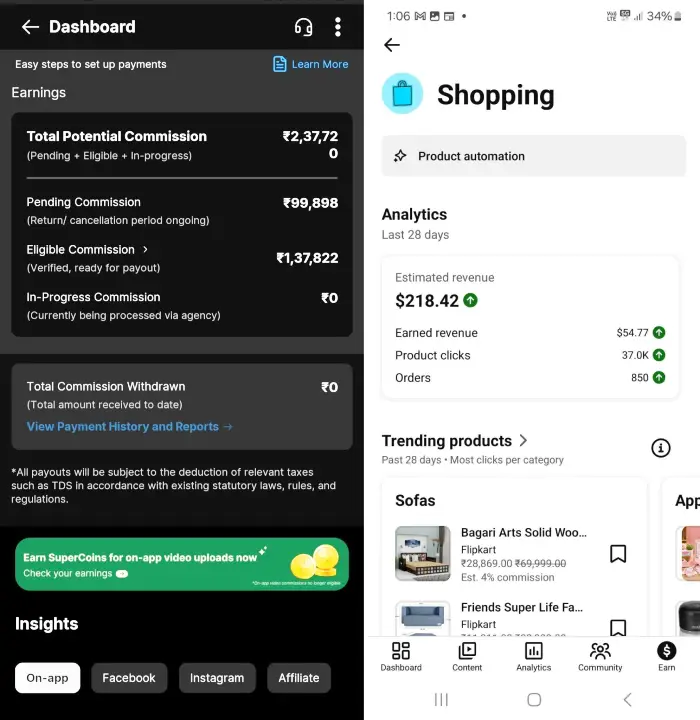
Source for both screenshots: Safikul Islam, supplied September 28, 2026. Left: affiliate commission dashboard. Right: YouTube Shopping analytics. Screenshots reproduced as supplied; neither shows Target Partners earnings.
The first screenshot shows ₹2,37,720 in total potential commission, comprising ₹99,898 pending and ₹1,37,822 eligible. In-progress commission and total commission withdrawn are both ₹0. No reporting period or Facebook-only breakdown is visible, so this image alone does not establish a monthly Facebook payout or a US-dollar equivalent.
The YouTube Shopping screenshot covers the last 28 days and shows $218.42 in estimated revenue, $54.77 in earned revenue, 37.0K product clicks and 850 orders. The estimated figure is separate from the earned figure and should not be presented as cash already received.
These distinctions matter when evaluating any affiliate program. My recommendation is to track potential commission, finalized earnings and actual payouts separately, then judge your content against the results that become payable.