


Affiliate marketing is a business model where you earn a commission for referring customers to another company. You publish useful content, share a tracked affiliate link, and receive payment when someone completes an eligible purchase or another agreed action.
For beginners, the practical starting point is one audience, one publishing channel and a small number of relevant products. Learn what your readers need, help them make a decision, and check whether those recommendations produce approved commissions.
I recommend treating this as a small publishing business. Your content is the work, your audience is the relationship, and commissions are one way that work can earn revenue.
This guide to affiliate marketing for beginners explains the basics, the setup process, realistic costs and the numbers worth measuring. You can follow it without previous affiliate experience.
What is affiliate marketing?
Affiliate marketing connects a seller with an independent person or business that promotes its products. The seller pays for a result defined in the affiliate agreement, such as a qualifying purchase or an approved lead.
Here are the main people and systems involved:
| Term | Meaning | Example |
|---|---|---|
| Affiliate or publisher | The person or business referring potential customers | A content creator publishing a microphone comparison |
| Merchant or advertiser | The company paying for eligible referrals | The shop selling the microphones |
| Affiliate program | The seller’s partnership offer and rules | Its commission terms, eligible products and promotion rules |
| Affiliate network | A platform connecting partners and supporting functions such as tracking and payments | A platform through which you apply to individual advertisers |
| Customer | The person considering or buying the product | A reader choosing equipment for a first podcast |
Some merchants manage their programs directly. Others use a network or partnership platform. Opening a network account does not automatically mean every advertiser has approved your application.
The affiliate marketing business model usually does not require you to manufacture products, hold stock or handle delivery. The merchant manages the transaction. Your responsibility is the accuracy and usefulness of your product promotion.
How does affiliate marketing work?
A typical sale-based arrangement follows this sequence:
1. You apply to a program and receive approval.
2. You create an affiliate link using the program’s tools.
3. You include that link in relevant content with a clear disclosure.
4. A reader follows the link and completes an eligible action.
5. The program attributes the action and checks it against its rules.
6. An approved commission becomes payable according to the payment schedule.
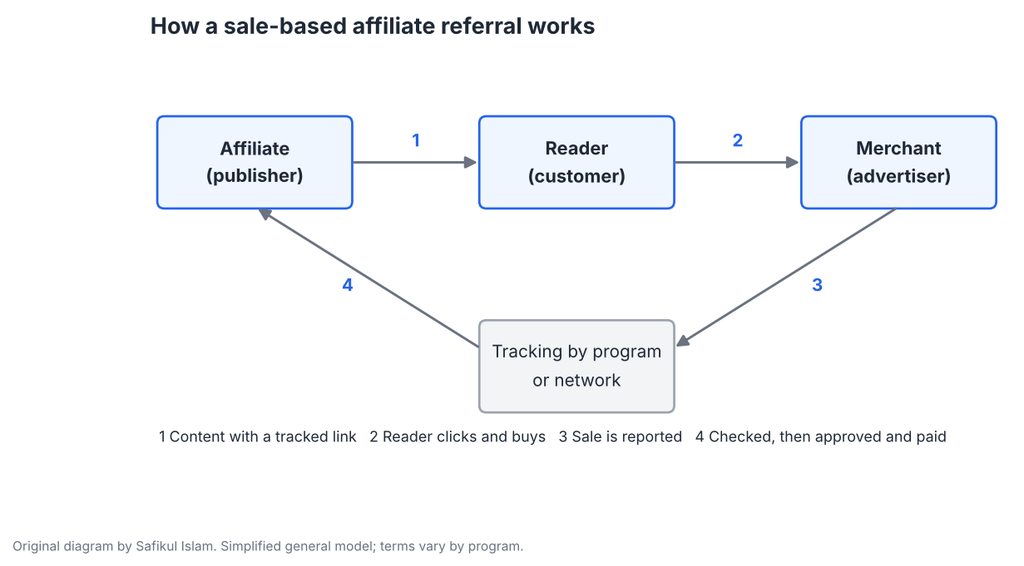
Your referral link contains information that helps identify your account. A tracking ID or an approved sub-ID may also distinguish one article or placement from another.
A click alone usually does not earn money in a sale-based program. A qualifying purchase must satisfy the agreement: the product, customer, location and promotion method can all matter.
What does cookie duration mean?
Cookie duration commonly describes the period during which a referral may remain eligible for attribution after a click. It is one part of the tracking rules, not a guarantee that every purchase during that period belongs to you.
Another affiliate’s referral, excluded products, tracking restrictions, device changes or a cancelled order may affect credit. Programs can use different attribution methods, so check the actual agreement instead of assuming every merchant uses the same cookie system.
For example, Amazon’s explanation of its referral session describes a 24-hour window, starting when the customer arrives through your link, for placing qualifying items in the cart. The window can end earlier if the customer submits the order or returns through another Associate’s link, and the commission is credited only after the customer has bought the item, accepted delivery and paid in full. That is more specific than saying every Amazon purchase within 24 hours earns a commission.
Beginner guides often say that brand cookie windows of 30 days or more are common. Treat that as a general observation only. Your own agreement is the only source that matters for the offer you promote.
How affiliate marketers get paid
The payment model tells you what result earns a commission. The payment schedule tells you when you can receive it.
| Payment model | What can earn a commission | What to verify |
|---|---|---|
| Cost per sale | An eligible purchase | Percentage or fixed fee, exclusions and returns |
| Cost per action | A defined action, which may include a sale, trial or lead | The exact action and its validation conditions |
| Cost per lead | An approved inquiry or signup | Lead quality, duplicate rules and eligible locations |
| Recurring commission | Eligible repeat subscription payments | Duration, renewals, cancellations and any cap |
Revenue sharing often means receiving a percentage of eligible revenue. A fixed commission pays an agreed amount per qualifying result. Neither arrangement is automatically more profitable.
Separate these three amounts in your records:
- Reported earnings: commissions appearing in the dashboard, potentially still pending.
- Approved earnings: commissions that have passed the relevant checks.
- Paid earnings: money actually transferred to your payment account.
For example, impact.com’s payment documentation explains pending, locked, clearing, overdue and reversed actions. Returns can cause reversals, while payment requirements and brand funding can affect payout timing.
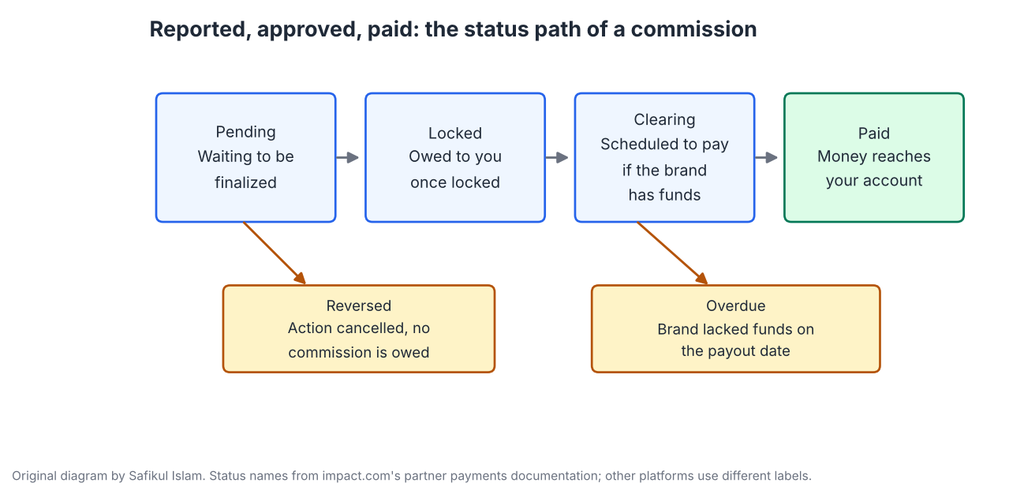
A payment threshold is the minimum balance needed for withdrawal or payment under the relevant rules. Also check payment currency, transfer fees, identity verification and required tax information before applying.
As a real example, Shopify’s affiliate help page says payments are issued through impact, that you need a balance of at least $10 USD (or the local equivalent) to withdraw, and that funds can go to a bank account or PayPal. Check the page for current terms before you plan around them.
Affiliate marketing examples
Here are real programs and platforms mentioned in this guide, described only as far as their own pages say. They show how different two offers can look, even when both are called affiliate marketing.
| Program or platform | What the official page describes | What a beginner should note |
|---|---|---|
| Amazon Associates | A 24-hour referral session for qualifying items placed in the cart, with commission credited after the customer pays in full | Session rules and early-ending conditions matter more than the headline window |
| Shopify Affiliate Program | A commission for each user who signs up for a paid plan through your link, with an application review | Requires an active website, an established audience, original content and relevant experience |
| impact.com (network) | A platform where many brands run programs and where actions move through pending, locked, clearing, overdue or reversed | Joining the network does not mean any advertiser has approved you |
| Retail brand programs | Each brand sets its own commission, eligibility and rules; see my Target affiliate program guide for one worked look | Confirm current terms with the program before you plan around it |
These are examples of how programs work, not recommendations. Program terms change, so open each page and read the current terms. For a retail brand, my Target affiliate program guide shows how to examine a single offer.
Types of affiliate marketing
You will often see three labels describing the publisher’s relationship with a product:
- Unattached affiliate marketing: promotion without an established personal connection or relevant expertise. This can include advertising-led campaigns.
- Related affiliate marketing: promotion to an audience interested in your subject, even when you have not personally used every product.
- Involved affiliate marketing: recommendations based on your own use of the product.
These are descriptive categories, not official account levels or payment models.
My preference for a beginner is to start with products you can evaluate properly. If you have used something, explain what you did and what you observed. If you have only researched it, describe the content as a researched comparison. Personal experience should never be invented to make a recommendation sound stronger.
Benefits of affiliate marketing—and the work involved
The benefits of affiliate marketing include avoiding inventory, choosing a subject you understand and earning from content that can help readers repeatedly. You can also learn useful skills in writing, research, search optimization and audience development.
There are limits. Merchants control their offers and commissions. Products become unavailable. Programs close or change their terms. Traffic fluctuates, and an article needs maintenance when its recommendations become outdated.
Content may continue earning after publication, but that does not make the business maintenance-free. Build a schedule for checking links, reviewing offers and improving your strongest pages.
How to start affiliate marketing step by step
This affiliate marketing beginner guide uses a simple working example: a new publisher helping home-office workers choose practical equipment. The example is hypothetical, not a reported business result.
Step 1: Choose a specific audience and problem
Start by completing this sentence: “I help [a specific audience] choose [a type of solution] for [a specific need].”
For our example: “I help people working in small home offices choose equipment that fits a limited desk and budget.”
That gives you clearer content ideas than a broad topic such as technology. You could cover compact keyboards, monitor arms, webcams or basic cable management.
Before committing, ask:
- Can I explain the buying decisions in this topic accurately?
- Can I access products, demonstrations or reliable documentation?
- Are people already asking specific questions about these products?
- Are suitable programs available for my country, audience and channel?
- Could I create several useful articles without repeating the same advice?
I would shortlist a few options and choose the one where useful content is easiest to produce consistently. A high commission rate cannot fix a topic you do not understand.
Step 2: Choose one main publishing channel
You do not need to launch a blog, newsletter and five social accounts together. Pick a channel that suits the buying decision and your ability to explain it.
| Channel | A useful starting format | Main planning consideration |
|---|---|---|
| Website or blog | Comparisons, tutorials and detailed buying guides | You need to maintain the site and attract readers |
| YouTube | Demonstrations, setup walkthroughs and product tests | Clear visuals and accurate explanations take preparation |
| Social media | Short demonstrations and focused recommendations | Link features, platform rules and reach vary |
| Email newsletter | Relevant recommendations for an opted-in audience | Check whether the program permits affiliate links in email |
A website gives you space to explain trade-offs. Video can be useful when people need to see how a product works. Social content can help you learn which questions attract interest.
For the home-office example, I would begin with a blog if writing is the creator’s strength, or video if they can demonstrate equipment clearly. The channel should support the recommendation.
Step 3: Prepare your channel and check requirements
Affiliate marketing requirements vary. Some programs accept newer creators; others expect an established audience, an active website or relevant experience.
For example, the Shopify Affiliate Program requirements include an active website, an established audience, original content and relevant commerce experience. Free enrollment does not mean automatic acceptance.
Before applying, prepare an honest description of your audience, your publishing channel and how you intend to promote products. Add clear contact information and the relevant disclosure and privacy information for your setup.
I suggest publishing three useful pieces first: a problem-solving guide, a product comparison and a practical checklist. This is my preparation recommendation, not a universal program requirement.
If you have no experience, focus on demonstrating care and clarity. Do not inflate traffic, claim partnerships you do not have or submit an empty profile as an established business.
Step 4: Compare a small number of affiliate programs
Search for the brands your audience already considers, then visit their official partnership pages. You can also discover merchants through affiliate networks.
Evaluate the whole offer:
| Check | Question to answer before joining |
|---|---|
| Audience fit | Would my readers reasonably need and be able to buy this product? |
| Eligibility | Are my country, channel and business setup accepted? |
| Commission rate | What applies to these products and customers, rather than the advertised maximum? |
| Attribution | What is the referral window, and what can override my credit? |
| Promotion rules | Are email, social posts, paid ads, discount codes or direct links permitted? |
| Payment | What are the threshold, schedule, currency and verification requirements? |
| Customer experience | Are pricing, support, availability and refunds suitable for my audience? |
For a retail example, my Target affiliate program guide explains how to examine an individual offer. Confirm current eligibility and terms with the program before making plans around it.
I recommend starting with one or two suitable programs. That makes it easier to learn their rules and maintain accurate content.
Step 5: Create content around a buying decision
A useful affiliate page helps someone decide what to do next. It should remain helpful even if the reader never clicks a commercial link.
For our home-office publisher, a first content set could be:
- “How to measure your desk before buying a monitor arm.”
- “Clamp vs freestanding monitor arms for a small desk.”
- “What to check before choosing a webcam for video calls.”
Each topic solves a specific problem. It also creates a natural place for a recommendation when a product is relevant.
A clear review should explain who the product suits, what you evaluated, its useful features, meaningful drawbacks and alternatives. Include original evidence where you have it. State any limits to your testing.
Google’s guidance on high-quality reviews emphasizes evidence, meaningful comparisons and reasons behind recommendations. A rewritten product description gives readers little help choosing between alternatives.
If you cannot test a product, you can still explain specifications, compatibility or purchase criteria from reliable sources. Label that work accurately and avoid presenting it as hands-on testing.
Keep a simple content plan: reader question, intended format, supporting evidence, relevant product and next review date. Build the plan around questions you can answer well, then expand as readers reveal new needs.
Step 6: Add affiliate links and clear disclosures
Create links through your approved program dashboard. Check that each opens the intended product and retains the tracking information supplied by the program. Use approved tracking labels to distinguish pages where available.
Place links where they help the reader act: beside a relevant recommendation, in a comparison or after a useful explanation. Use descriptive text such as “Check the current specifications and price.” Do not invent urgency or claim a discount you have not verified.
Make the commercial relationship clear. A plain-language example for an article is:
“I may earn a commission if you buy through links in this article.”
The FTC’s endorsement guidance explains that the relationship should be disclosed clearly and conspicuously. The FTC says the words “affiliate link” alone are not adequate. Plain wording such as “I get commissions for purchases made through links in this post” works better. Put the disclosure where readers encounter the recommendation, because a distant footer is easy to miss, and repeat it when the layout requires it to remain clear.
For video, the FTC says to disclose the relationship in the video itself and in the description near the links, because a description-only disclosure is easy to miss. It also says a hashtag or a platform’s built-in tool does not guarantee a clear disclosure, so add your own plain statement.
For content aimed at Indian audiences, also review ASCI’s influencer advertising guidance. Its guidance addresses visible labels and warns against hiding disclosures in a bio or deep in a caption. Requirements depend on the market and content format; video may need disclosure within the video itself.
On a website, qualify commercial affiliate links with rel=”sponsored”. Google’s guidance on qualifying outbound links asks you to mark links that are advertisements or paid placements with the sponsored value. That page does not name affiliate links specifically, but links that earn you a commission are commonly treated this way. Your CMS or link settings may provide this option. A technical link attribute does not replace a disclosure readers can understand.
Step 7: Attract relevant traffic
You need people with a reason to care about your recommendation. Large visitor totals and a lot of referral traffic are less useful when the content attracts the wrong audience.
For search traffic, answer a clear question in the title and introduction, organize the page logically and link to related explanations. My SEO guides cover the wider work involved in making useful pages discoverable.
For social media, turn one section of a guide into a short demonstration. Show the problem and the solution before inviting people to read more. Participate in communities by answering questions, and follow their rules about promotion.
If you build an email audience, ask people to subscribe voluntarily. Share useful updates and check program restrictions before adding commercial links.
I would avoid paid advertising at the beginning unless you understand both the program’s rules and the economics. Paying for referral traffic before measuring approved earnings can make an apparently busy campaign lose money.
Step 8: Measure results and improve one weak point
Record results by article or campaign, using approved tracking tools where available. Start with views, affiliate clicks, reported conversions, approved commissions, paid commissions and costs.
Look for the point where progress stops:
- Few relevant visitors: review topic selection and distribution.
- Visitors but few affiliate clicks: check whether the recommendation answers their question.
- Clicks but few conversions: check product fit, price, destination, availability and tracking.
- Conversions but low approved earnings: inspect exclusions, reversals and commission terms.
- Approved earnings but no payment: check the threshold, payment schedule and account requirements.
Small samples can be misleading. One sale is useful feedback, but it does not prove that a page will generate predictable income. Compare similar periods and allow time for approval before judging profitability.
How much does affiliate marketing cost to start?
There is no universal affiliate marketing startup cost. Your cash spending depends on the channel, the equipment you already own and the evidence needed to produce useful content.
Many programs are free to join, but publishing still takes time. A website may require hosting and a domain. Product testing may require purchases. Video production may use equipment you already have or require extra spending.
Here is a hypothetical first-month budget, not current vendor pricing or a recommended minimum:
| Expense | Illustrative spending cap |
|---|---|
| Domain and basic hosting allocation | $30 |
| Product access or testing materials | $40 |
| Optional tools | $0 |
| Paid advertising | $0 |
| Total planned cash spending | $70 |
Actual costs can be lower or higher. A provider may require annual payment upfront even when it advertises a monthly equivalent. Include taxes and renewal prices when comparing offers.
For a near-zero additional-cash start, use equipment you own and a permitted free publishing channel. Recommend only what you can evaluate responsibly. You still need time, internet access and a program that accepts your setup.
How to make money with affiliate marketing: a realistic example
Affiliate income depends on relevant attention, clicks, eligible conversions and the amount paid per conversion. The commission rate is only one part of that calculation.
Many guides quote averages, so I want to be careful here. Shopify’s June 2026 guide says everyday products typically pay 5% to 18% commission and most programs pay around 10%. Those are that guide’s own figures, and rates vary by program and product category. Some guides also repeat survey-based income averages, which are self-reported and can be dated. None of that tells you what your own first month will look like, so I prefer to calculate from your own funnel.
Consider this original, hypothetical example:
- A buying guide receives 1,000 visits.
- Ten percent of visitors click an affiliate link: 100 clicks.
- Four percent of those clicks produce credited orders: four orders.
- Each order has $80 in eligible value, with a 5% commission: $4 per order.
- Reported commission is 4 × $4 = $16.
- One order is returned and its commission reversed: approved commission becomes $12.
These are teaching assumptions, not industry averages, expected results or a program’s advertised terms.
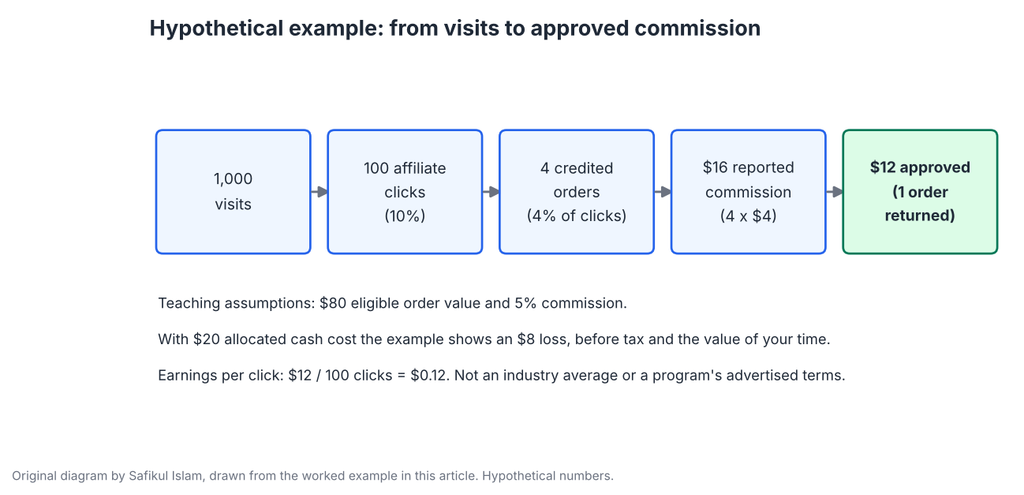
At $20 in allocated cash costs, the example produces an $8 loss before tax and before valuing the creator’s time. It would also remain unpaid if the relevant payout threshold had not been reached.
Approved earnings per click in this example are $12 ÷ 100 = $0.12. Here, that means earnings per single click. Some dashboards use a different EPC basis, so check the definition before comparing programs.
Use the same reporting period and a sufficiently settled group of referrals. Comparing this week’s clicks with last month’s approved commissions can produce a misleading result.
Affiliate marketing mistakes beginners should avoid
The most expensive mistakes often begin with a weak decision rather than a broken link.
| Mistake | Better starting decision |
|---|---|
| Choosing only by commission | Compare audience fit, conversion potential and approval rules |
| Recommending everything | Focus on a small set of products you can explain accurately |
| Copying merchant descriptions | Add decision criteria, evidence, limitations and alternatives |
| Hiding the relationship | Put an understandable affiliate disclosure near the recommendation |
| Ignoring program restrictions | Check approved channels, advertising rules and link usage |
| Treating dashboard totals as cash | Track reported, approved and paid amounts separately |
| Expecting immediate income | Use early work to validate the topic, content and referral process |
| Forgetting maintenance | Review links, availability and recommendations regularly |
Be particularly careful with offers that promise guaranteed income or require an unexplained payment to unlock commissions. Verify the company and terms through its official channels before sharing information or spending money.
A 30-day affiliate marketing strategy for beginners
Use the first month to build a working foundation. This schedule is a suggested learning plan, not a promise of sales within 30 days.
| Period | Main work | Concrete result |
|---|---|---|
| Days 1–7 | Choose an audience, research questions and inspect program eligibility | One clear niche, one channel and a shortlist of suitable offers |
| Days 8–14 | Prepare the channel and publish useful starter content | A credible profile and three original pieces |
| Days 15–21 | Apply to suitable programs and set up approved links after acceptance | A documented application and tracking process |
| Days 22–30 | Distribute content, answer questions and review available data | A list of improvements based on actual reader behavior |
Approval may take longer or an application may be declined. Continue improving the content while you wait. Do not present yourself as an approved partner before acceptance.
At the end of the month, ask whether you can explain the audience’s needs more clearly, maintain your recommendations and identify the next useful topic. Those are meaningful early signs of progress.
Affiliate marketing launch checklist
- I can describe the audience and the problem my content solves.
- My publishing channel contains useful, original content.
- My selected program accepts my location and promotion method.
- I understand the commission, attribution and payment terms.
- My recommendations distinguish research from personal testing.
- My disclosure is easy to see and understand.
- My approved links open the intended destination.
- My website’s commercial links use the appropriate relationship attribute.
- I can separate pending commissions, approved earnings and cash received.
- I have a date to review product information and broken links.
Frequently asked questions
Yes, you can start learning, publishing and evaluating suitable programs without previous affiliate experience. You still need useful content and must meet each program’s entry requirements. Begin with a subject you can explain honestly and build from there.
Some programs allow approved social channels, video content or other publishing formats. Others require a website. Check both the merchant’s conditions and the platform’s rules before deciding on a website-free approach.
There is no universal follower requirement across affiliate marketing. Some programs specify audience criteria; others assess your content and promotional approach. A relevant audience matters, but a small following does not guarantee acceptance or earnings.
There is no reliable timeline for every beginner. Approval, content quality, traffic and the buying decision all affect timing. Your first reported commission may also take time to become approved and paid.
The best fit is a program that accepts your setup, offers products useful to your audience and has terms you understand. Start with suitability and customer experience, then compare commission economics. A popular brand is not automatically the right choice.
No. An affiliate generally refers the customer to a merchant and receives commission on an eligible result. In a dropshipping business, you sell to the customer through your own storefront while a supplier fulfills the order. Your role and responsibilities differ.
AI can help organize notes, suggest questions and improve a draft. Verify claims against reliable sources and keep your judgment in the final recommendation. Do not use generated text or images to imply product testing that never happened.
Choose one audience, write down five buying questions and select one you can answer well. Check suitable programs while creating your first useful piece of content. Apply when your channel meets their requirements, then add approved links and clear disclosures.
My advice is to make the first recommendation genuinely useful before expanding the business. A clear explanation of who should buy a product—and who should skip it—gives readers a reason to trust the next thing you publish. Explore my affiliate marketing guides as you evaluate individual programs.