
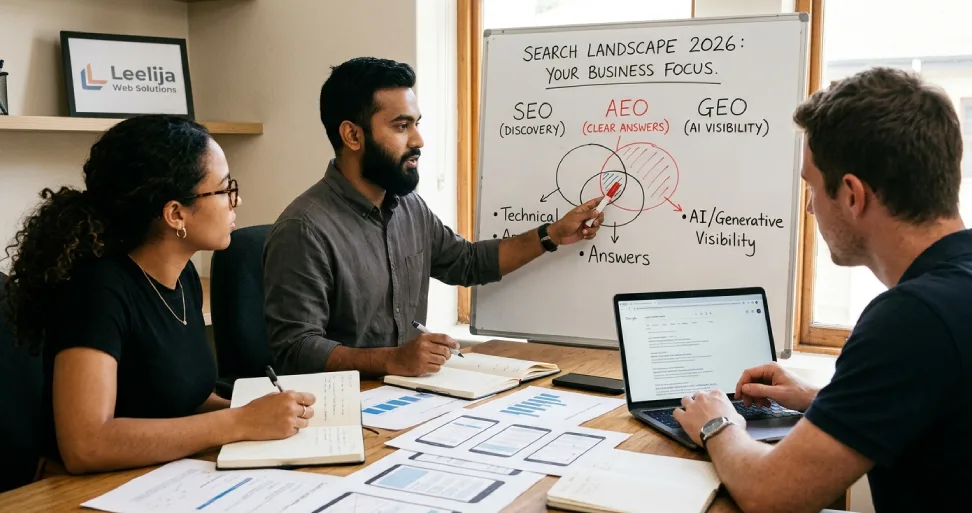
SEO vs AEO vs GEO describes three overlapping approaches to search visibility. Search engine optimization helps people discover your content through search. Answer engine optimization focuses on making your content useful as a direct answer. Generative engine optimization focuses on visibility and accurate representation in AI-generated responses.
For a business owner, the practical decision is where to invest your next hour and your next marketing budget. Should you improve an existing service page, answer customer questions more clearly, or investigate why your business is missing from AI recommendations?
I would make that decision from the problem your business faces. The acronym comes second.
In this guide, I explain the differences, show how the work fits together, and outline a way to measure progress without confusing a mention with a sale.
SEO vs AEO vs GEO at a glance
The table below uses a practical working definition for each term. These are overlapping marketing disciplines, not three independent systems you can switch on.
| Approach | Main focus | Practical example |
|---|---|---|
| SEO — Search engine optimization | Discovery through search results, including the technical and content foundations | A relevant service page appears when someone searches for a provider |
| AEO — Answer engine optimization | Clear, reliable answers to specific questions | A useful explanation is selected for a featured snippet or another answer experience |
| GEO — Generative engine optimization | Visibility and accurate use of your content or brand in generated answers | An AI search response cites your guide or includes your business in a relevant comparison |
SEO includes more than traditional blue links. AEO can include AI answers. GEO can involve both your website and third-party information about your business. A single page may support all three goals.
Why different guides define AEO and GEO differently
The terminology is still used inconsistently. For example, HubSpot’s own AEO guidance applies the term to AI platforms including ChatGPT, Gemini and Perplexity. Other guides use AEO more narrowly for direct answers and reserve GEO for generated responses.
For this article, I use AEO to discuss answering questions clearly and GEO to discuss visibility in generated answers. That distinction helps organize the work; it does not mean the two have a fixed technical boundary.
The terminology is not the only inconsistency worth flagging. Search for this topic yourself and you will find comparison guides citing very different, precisely stated numbers for the same thing: AI Overview prevalence quoted anywhere from under 5% to 25% of queries, click-through-rate declines of 41%, and correlation statistics from studies that are rarely linked to their original source. A confident, round number is not the same as a verified one. Where I cite a figure in this article, I have linked the source; where a claim is common but unverifiable, I have left it out rather than repeat it because everyone else does.
Whether you search for SEO vs GEO vs AEO or AEO vs SEO vs GEO, the business question remains the same: how can the right customer discover, understand and trust your information?
What SEO means for your business
SEO is the practice of improving how search engines discover and understand your content, and how useful that content is to people searching for it. Google’s SEO Starter Guide is a useful reference for the fundamentals.
The work includes resolving crawl and indexing problems, organizing pages clearly, matching content to search intent, and using descriptive titles and internal links. For a business, it also means giving visitors enough information to take the next step.
A website development service page, for example, should explain what you build, who the service suits, how the process works and how someone can request a proposal. Adding the phrase “website development company” repeatedly will not answer those questions.
My priority would be a page that earns relevant enquiries. Rankings and clicks help diagnose performance, but a high position for an unrelated keyword may have little commercial value.
You can explore these foundations in my SEO guides.
What AEO means for your content
AEO focuses on helping a reader or answer system find a clear response to a specific question. The answer should be understandable without forcing someone to read several paragraphs of introduction first.
Consider a customer asking, “What should a website maintenance plan include?”
A useful answer would identify the services to check, explain important exclusions and tell the buyer what to ask the provider. A vague paragraph about digital transformation would leave the question unresolved.
My editorial approach is to state the answer, explain its conditions, then give examples or evidence. Use a table when someone needs to compare options, and use numbered steps when order matters. These choices improve usability; they are not a guaranteed formula for answer placement.
Google’s featured snippet documentation makes an important point: you cannot mark a page as a featured snippet. Google decides whether to select it. Google also does not specify one universal minimum answer length.
That is why I would avoid rewriting every answer to an arbitrary word count. Some questions need a sentence. Others need a careful explanation of costs, limitations or risks.
What GEO means for AI search visibility
GEO focuses on how your content and business appear in responses produced by generative systems. The goal can include a linked citation, a relevant brand mention or an accurate description of your offering.
These outcomes are different. An AI response can name a business without linking to it. It can cite an article without recommending the company that published it. Your measurement should preserve that distinction.
The research paper GEO: Generative Engine Optimization introduced a framework for evaluating content visibility in generative responses. Its experimental improvements are frequently quoted in marketing. They should not be treated as a promised percentage increase for every website or current AI platform.
For practical content planning, I would ask what information a buyer needs to make a sound comparison. That could include product specifications, service scope, evidence from a documented project or a clear explanation of when your offering is unsuitable.
An AI-generated answer may combine information from several sources. Publishing accurate material on your website matters, but it does not give you control over everything written about your brand elsewhere.
Is GEO replacing SEO?
No. For Google, there is a documented connection between ordinary search foundations and AI search. Google’s AI optimization guide explains that its generative features rely on its search index and core ranking and quality systems.
That makes technical access and useful content relevant to both. It does not mean a high organic ranking guarantees inclusion in an AI answer, or that every other AI platform works exactly like Google.
I would keep investing in valuable search pages while adding measurement for AI visibility. Abandoning pages that bring qualified customers simply because a new label is popular would be a poor business decision.
For a broader implementation guide, read my article on how to optimize for AI search.
One business example showing how all three work together
Imagine a software company publishing a guide titled “How to Choose Billing Software for a Small Retail Store.” This is an illustrative example, not a reported client result.
The SEO work
The company makes the guide publicly accessible, checks indexing settings, chooses a descriptive title and links to it from relevant product and support pages. The article addresses the actual buying decision rather than loosely related technology topics.
The AEO work
The guide answers specific questions, such as “Can billing software work offline?” and “What should I check before importing my stock data?”
A helpful answer to the first question might read:
“Some billing software supports offline use, but the available functions vary. Ask whether you can create invoices, update stock and accept payments without internet access, and how records synchronize when the connection returns.”
That answer gives the reader a concrete verification task. The company should then describe its own product accurately, including limitations.
The GEO work
The company adds verifiable feature details, dated screenshots and a comparison method that explains which requirements matter for different stores. It checks that its public product descriptions are consistent and reviews how relevant AI searches describe the product.
If an answer incorrectly says the software supports a feature, the team investigates its own pages and any cited external sources. Correcting misleading information becomes part of the work alongside increasing visibility.
The result is one stronger resource serving several discovery experiences. It does not require three near-identical articles labelled SEO, AEO and GEO.
Which approach should you prioritize first?
Start with the constraint you can observe. I would use the following decision table before commissioning a new package or buying another tool.
| Your situation | First priority | Why it comes first |
|---|---|---|
| Important pages cannot be crawled or indexed | Technical SEO and access checks | Better wording will not resolve an access restriction |
| Pages attract the right searches but answer questions poorly | Content improvements with an AEO focus | Visitors need a clear, complete response |
| Search performs reasonably well but AI answers omit or misdescribe you | GEO research and measured experiments | You need to understand the specific platform and information gap |
| You receive visits but few qualified enquiries | Offer clarity and conversion analysis | More visibility may amplify the same business problem |
For a new website, I would establish the technical foundation and publish a small set of genuinely useful pages first. For an established business, I would start with pages that already serve a valuable audience and improve the missing answers or evidence.
There is no universal percentage of budget that must go to each acronym. Ask your agency to identify the deliverable, explain the problem it solves and define how the result will be assessed. Also ask which tasks overlap with work you already pay for.
A practical strategy for SEO, AEO, and GEO
Check access before rewriting content
Review your important public URLs, indexing instructions, canonical URLs, internal links and server restrictions. Investigate problems on actual pages rather than relying only on a general site score.
For ChatGPT search, OpenAI’s crawler documentation distinguishes OAI-SearchBot from GPTBot. The former supports search discovery; the latter concerns model training. You can allow search access while making a separate decision about training. A crawler visit alone does not prove a citation.
Google also provides a Search generative AI control under Search Console settings. Inclusion is the default, but a property may inherit a parent’s choice. If AI visibility is your goal, check for an unintended exclusion. This setting is separate from model-training controls and ordinary search inclusion.
Research decisions your customers actually make
Build a short list from sales enquiries, support questions and relevant search-query data. Identify the audience, the decision and the information required to make it.
For example, “SEO services” is a broad subject. “What should a small business expect in a monthly SEO report?” gives you a clearer task. You can explain useful metrics, common reporting gaps and questions to ask a provider.
Avoid creating separate pages for every rearrangement of the same keyword. Cover the intent thoroughly on an appropriate page.
Improve the answer and the evidence together
Start with a clear response. Add the conditions that might change it. Support specific claims with original evidence or relevant primary sources.
A comparison benefits from a disclosed method. A case study needs a timeframe and an explanation of what changed. A pricing page should make inclusions and exclusions understandable. Describe actual experience when you have it; do not invent a test to make an article sound authoritative.
My preference is to improve five commercially useful pages before publishing dozens of shallow variations. Readers should find something they can use, not another version of an answer available everywhere else.
Make business information consistent
Keep your company name, services, contact details and public product descriptions accurate. Correct outdated information where you have control, and request corrections from other publishers when appropriate.
Relevant editorial coverage and authentic customer feedback can give people more information about your business. Avoid presenting mentions or backlinks as a guaranteed route into AI recommendations. Google’s spam policies also apply to manipulative link schemes and scaled content abuse.
Use structured data for its intended purpose
Structured data helps describe page content and can support eligibility for applicable Google rich results. Use types appropriate to the page, and ensure the markup reflects visible, accurate information.
It is not an AI recommendation switch. Google says no special AI schema is required and that llms.txt does not improve visibility in Google Search. Treat claims about other platforms separately and ask for supporting documentation.
How to measure SEO vs AEO vs GEO
A useful report connects visibility to business outcomes while keeping each observation clear.
For SEO, review relevant impressions, clicks, search queries and landing pages alongside qualified enquiries or sales. A ranking change provides context, but it does not explain the entire customer journey.
For direct-answer visibility, record whether your page appears in the particular answer feature you are monitoring. Save the query, date and relevant location or device context. Avoid turning one screenshot into a claim about every searcher.
For generative answers, distinguish these observations:
- Brand mention: the response names your business.
- Linked citation: the response links to your website or a particular page.
- Accuracy: the response describes your offering correctly.
- Referral visit: someone reaches your site through an identifiable AI source.
- Business outcome: the visit produces an enquiry, sale or another defined action.
Google’s Search Generative AI performance reports provide dedicated impression views with page, country and date breakdowns, plus devices for Search. Google states that the reports rolled out worldwide on August 31, 2026. These views complement overall reporting; they are not a complete record of AI-driven sales.
A simple way to track sampled citation visibility
Choose a fixed set of relevant questions and run repeated checks on each selected platform. Record every valid response, including those without a citation to you. Keep failed requests separately rather than counting them as valid answers.
For illustration, if 12 of 60 recorded answers contain a link to your domain, your domain citation rate in that sample is 20%. Count each answer once even if it contains several links to you.
That is a sample result, not your share of the entire AI search market. Record the questions, platform, dates and relevant settings so future comparisons have context. Track branded and non-branded questions separately, since asking directly about your company changes the task.
Review identifiable referrals and conversions alongside these observations. Some people may see your brand in an answer and visit later through another route, so attribution will remain incomplete.
A 30-day action plan for a small team
During the first week, choose five important pages, document their purpose and record a baseline. Check technical access and identify the questions each page leaves unanswered.
In week two, revise the weakest explanations. Add examples, limitations and sources. Remove repeated introductions and claims you cannot substantiate.
In week three, review internal links, business details, relevant structured data and the experience on mobile. Make sure the improvements are visible on the published page.
In week four, repeat your visibility checks and review any referral or enquiry data. Record what changed and choose the next improvements. Avoid attributing every movement to your edits; search systems and competitors change too.
This is a schedule for completing useful work, not a promise of rankings or citations within one month.
Frequently asked questions
SEO addresses search discoverability, AEO emphasizes direct answers, and GEO emphasizes visibility in generated responses. Their activities overlap, and the definitions of AEO and GEO vary across providers.
They can describe much of the same work. Some businesses use AEO for all AI answer visibility, while others reserve GEO for generative systems. When comparing services, examine the actual tasks and measurement method.
In this comparison, GEO means generative engine optimization. Local SEO concerns discovery for location-related searches and businesses. Local information may appear in AI answers, but the terms describe different focuses.
Usually, you can build one coordinated plan. Clear answers, accurate evidence and accessible pages support several discovery experiences. Assign additional tasks where a platform or measurement need genuinely differs.
Yes. You can improve content, inspect technical access and record a small sample of AI results manually. A paid tool may help scale monitoring, but check its prompt coverage, platforms and definitions before trusting its score.
No. You control your website and publishing decisions, while search systems control selection. Evaluate a strategy through documented improvements, repeatable observations and business outcomes.
My advice for business owners
The useful lesson from SEO vs AEO vs GEO is to connect your search work to the questions customers ask and the evidence they need.
Start with a website people can find and use. Improve the answers that matter to buyers. Then check whether your business is represented accurately across the search experiences relevant to your audience.
As CEO of Leelija Web Solutions, I approach this from the combined perspective of website development and digital marketing. Technical implementation and useful content need to support the same business goal.
Choose one important page this week. Make its main answer clearer, resolve one meaningful gap and record your starting point. That gives you something concrete to improve and measure, whichever acronym you use.