

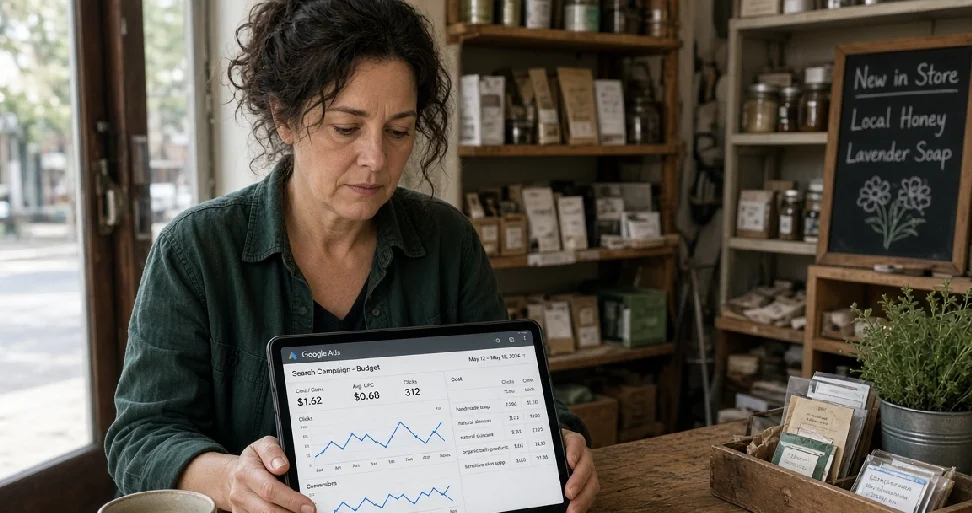
Pay per click advertising can put your business in front of people who are looking for what you sell. But buying traffic and acquiring profitable customers are two different outcomes.
Before spending money on a campaign, I would ask three questions: who are we trying to reach, what should they do after clicking, and how much can the business afford to pay for that result?
Those questions make the decisions about keywords, budgets and agencies much clearer. This guide explains how PPC works, how to judge its economics and what to expect from professional management.
What is pay per click?
Pay per click, or PPC, is an online advertising model in which an advertiser pays when someone clicks an ad. Businesses use it to attract visitors to products, services and other offers. The click creates an opportunity for a sale or lead; it does not guarantee either.
PPC describes the payment model. Cost per click, or CPC, describes the cost of an individual click or the average across multiple clicks. Amazon’s CPC advertising guide explains these related terms.
For example, spending $300 on 150 clicks produces an average CPC of $2. Whether that is worthwhile depends on what those visitors do next and the value of the customers acquired.
How does pay per click advertising work?
A typical search advertising journey looks like this:
1. Someone searches for a product or service.
2. The advertising platform identifies eligible ads.
3. An auction determines which ads can appear and their placement.
4. A person clicks an ad and reaches the advertiser’s landing page.
5. The advertiser measures actions such as purchases, enquiries or bookings.
In Google Ads, the highest bid does not automatically win the best placement. Ad Rank incorporates the bid, auction-time ad quality, thresholds, competition, search context and expected effects of ad assets. See Google’s Ad Rank documentation.
Your actual CPC is the final amount charged for the click. It is not necessarily the maximum bid you set; auction conditions and the bidding strategy affect the outcome. Google explains the distinction in its actual CPC guidance.
Quality Score is a diagnostic, not the auction formula
Google’s displayed Quality Score ranges from 1 to 10 and helps identify issues with expected click-through rate, ad relevance and landing page experience. Google explicitly says that this score is not an input in the ad auction.
Use the Quality Score report to investigate weaknesses. Avoid treating “bid multiplied by Quality Score” as a complete description of how a modern auction works.
My priority would be to make the ad and destination more useful to the intended customer. Improving a diagnostic number is only meaningful when it supports that goal.
Where can businesses run PPC campaigns?
Paid search is one common starting point, but paid advertising covers several formats and billing arrangements.
| Campaign environment | Potential use | What to check before spending |
|---|---|---|
| Search ads | Reach people actively researching a solution | Search intent, relevant queries and landing-page fit |
| Product advertising | Promote specific products | Feed accuracy, stock, pricing and product margin |
| Display and remarketing | Reach audiences while they browse or revisit an offer | Placement quality, audience rules and billing model |
| Social and video advertising | Introduce offers and build interest | Creative quality, audience fit and how charges are calculated |
Google Ads provides Search, Shopping and other campaign types. Amazon Sponsored Products is a specific example of cost-per-click product advertising.
Do not assume every social, video or display campaign is billed per click. Some use impressions, views or other billable events. A dashboard may report CPC even when clicks are not the billing basis.
For a small business with clear search demand, I would usually investigate a focused search campaign before spreading a limited budget across several channels. That is a planning preference, not a rule for every business.
PPC vs SEO: Which should you use?
PPC buys advertising exposure. Search engine optimization improves a website’s ability to earn visibility in unpaid search results. They serve related goals through different methods.
| Decision | PPC | SEO |
|---|---|---|
| Main investment | Media spend plus setup and management | Content, technical work and ongoing improvement |
| Speed of traffic | Can begin after approval and campaign delivery | Depends on discovery, competition and site development |
| When spending stops | Paid delivery generally stops when campaigns stop | Existing organic visibility may continue, but can change |
| Useful role | Test an offer or reach defined demand | Build useful content and a durable search presence |
I would not choose between them purely on which sounds faster. Consider cash flow, customer acquisition costs and how urgently the business needs demand.
For example, a new service page might use a limited PPC test while the website develops supporting content. Search-term and sales feedback can inform future content, without assuming that paid results predict organic rankings.
Explore my SEO guides for the organic side of that work.
How much does pay per click cost?
There is no useful universal price per click for every business. Competition, location, commercial intent, ad quality, audience and campaign configuration all influence what you pay.
Separate the total investment into three parts:
- Media spend: money paid to the advertising platform.
- Management: internal staff time or agency fees.
- Supporting work: landing pages, creative assets, analytics and other agreed services.
Use Google Keyword Planner to explore keyword ideas and cost estimates for the intended market. Treat forecasts as planning inputs, not guaranteed prices or sales.
A practical PPC budget example
The figures below are hypothetical. They illustrate the calculation and are not an industry benchmark or client result.
| Measure | Calculation | Example result |
|---|---|---|
| Advertising spend | Planned media budget | $1,000 |
| Average CPC | Assumed average click cost | $2 |
| Clicks | $1,000 divided by $2 | 500 |
| Leads | 500 clicks multiplied by 4% | 20 |
| Cost per lead | $1,000 divided by 20 | $50 |
| Customers | 20 leads multiplied by 20% close rate | 4 |
| Media-only customer acquisition cost | $1,000 divided by 4 | $250 |
If management and landing-page costs total another $400 for that period, the combined campaign cost per acquired customer becomes $350, assuming the same four customers and that allocation of costs.
A $2 click can therefore lead to a $350 acquisition cost. That is why I would review sales outcomes alongside the advertising dashboard.
Calculate what a lead is worth to your business
A useful planning relationship is:
Allowable cost per lead = allowable acquisition cost x lead-to-customer rate
If your business can afford $200 in acquisition cost and one in five leads becomes a customer, the corresponding lead-cost allowance is $40. Allocate that allowance across media and other acquisition expenses rather than treating it all as ad spend.
Use contribution after variable costs, realistic repeat purchases and the desired profit margin to decide what you can afford. Revenue alone is not a spending allowance.
Understand average daily budgets
For most Google Ads campaigns using an average daily budget, the daily spending limit is twice that budget and the monthly limit is 30.4 times it, subject to the platform’s rules for changes and partial months.
For example, an unchanged $20 average daily budget over a full month generally means a $608 monthly limit, with spending potentially reaching $40 on a particular day. Review Google’s spending-limit documentation for the campaign type you use.
“Average daily budget” should not be interpreted as an identical spend every day.
One recent change worth knowing if you use Ad Scheduling to limit delivery to business hours or certain days: as reported by Search Engine Roundtable and confirmed in Google’s own spending-limit documentation, Google Ads changed how it paces budgets for scheduled campaigns, effective June 1, 2026. Previously, a campaign restricted to weekdays only would typically spend close to its daily budget on each active day. Now, Google’s systems actively pace toward the full monthly limit, 30.4 times the daily budget, and compress that spend into whatever days or hours the schedule allows. The daily and monthly billing caps themselves have not changed, but a weekday-only or business-hours-only campaign can see noticeably higher spend per active day than it did before this rollout. If you restrict delivery for genuine operational reasons, such as staff availability, revisit your daily budget rather than assuming last year’s spend pattern still applies.
How to launch a focused PPC campaign
1. Define the business outcome
Choose the outcome before selecting keywords. An ecommerce campaign may aim for profitable orders. A service business may need qualified enquiries, booked consultations or completed sales.
Write down what counts as success and what does not. A page visit, a form submission and a paying customer are different events.
Also assign responsibility for follow-up. Generating enquiries creates little value if the business cannot respond promptly or deliver the service.
2. Set up and verify conversion tracking
Test the purchase, enquiry or booking process before launching. Confirm that the intended action records correctly and does not fire repeatedly during an ordinary visit.
In Google Ads, primary conversion actions can inform bidding when their associated goals are used by the campaign. Secondary actions normally support observation, although including them in a custom goal can make them biddable. Review the primary and secondary conversion guidance.
For lead generation, connect advertising outcomes with your sales records where possible. Google supports qualified-lead and converted-lead measurement, helping distinguish a submitted form from a valuable sales opportunity.
Choose tracking methods that fit the permissions you have and the applicable platform requirements. Document the conversion window and attribution settings so reports can be interpreted consistently.
3. Research keywords around customer intent
Build keyword groups around the actual service or product you sell.
For a web development business, “hire ecommerce website developer” suggests a different intention from “learn web development free.” Both involve development, but they should not automatically receive the same budget.
Match types also matter. In Google Ads, exact match can cover searches with the same meaning or intent; it is not restricted to identical characters. Phrase and broad match provide different levels of reach. Read the keyword matching documentation.
For a tightly controlled initial test, I would investigate focused intent groups and review the resulting searches before expanding. The appropriate match type depends on tracking quality, bidding strategy and the budget available to learn.
4. Add negative keywords thoughtfully
Negative keywords help exclude searches that do not fit the offer. A paid training provider, for example, might investigate whether searches for unrelated jobs are consuming budget.
Do not copy a large exclusion list blindly. A word such as “free” could appear in a valuable search for a service that genuinely includes a free consultation.
Google notes that negative keywords do not automatically cover close variants. Review its negative-keyword guidance and add exclusions based on the searches you intend to block.
5. Match the ad to a useful landing page
The landing page should continue the promise made in the ad.
If an ad offers ecommerce website development, send the visitor to a relevant service page with a clear offer, credible evidence and an appropriate enquiry form. A general homepage may force the visitor to find that information again.
Before paying for traffic, check:
- The page works well on mobile.
- The headline clearly describes the offer.
- Pricing or the quotation process is understandable.
- Forms, phone links and checkout steps function correctly.
- Claims in the ad can be supported by the page.
A campaign cannot compensate indefinitely for a confusing offer or a broken form.
6. Choose bidding and targeting deliberately
Select a bidding strategy that reflects the goal and the available measurement. Google’s Smart Bidding uses auction-time optimization for conversions or conversion value.
Automated bidding still needs sensible goals and reliable signals. Asking a system to maximize low-value actions can produce more of those actions without improving the business.
Review locations, languages, networks and schedules before launch. For a local service, confirm that geographic settings reflect the area you can actually serve; Google’s location-targeting documentation explains the available controls.
Start with a scope you can evaluate. Increasing reach is easier to justify after you understand the quality of the traffic already arriving.
What does pay per click management include?
Pay per click management is the ongoing work of planning, monitoring and improving paid campaigns against business goals.
A useful management process includes:
- Reviewing spend, delivery problems and tracking health.
- Checking search terms, targeting and exclusions.
- Comparing ads and landing-page performance.
- Evaluating lead quality or purchase value.
- Adjusting budgets and bids based on sufficient evidence.
- Reporting changes, outcomes and the next test.
I would monitor a new campaign closely for obvious faults, then review performance on a schedule appropriate to its spend and sales cycle. A business closing deals over several weeks should not judge customer acquisition from yesterday’s clicks alone.
Make changes with a reason and record them. Changing targeting, ads, bidding and landing pages simultaneously makes it difficult to understand what affected performance.
The PPC metrics that matter
| Metric | Basic calculation | What it helps explain |
|---|---|---|
| Click-through rate | Clicks divided by impressions x 100 | How often an impression produces a click |
| Average CPC | Ad spend divided by clicks | Average traffic cost |
| Click-to-conversion rate | Conversions divided by clicks x 100 | How often clicks produce the selected action |
| Cost per acquisition or action | Ad spend divided by the defined conversions | Cost of the outcome being counted |
| ROAS | Attributed revenue divided by ad spend | Revenue attributed per unit of media spend |
| Customer acquisition cost | Defined acquisition costs divided by new customers | Cost of acquiring a customer within the chosen scope |
Use consistent definitions. A platform’s conversion rate can use eligible interactions rather than only clicks, and “CPA” is only meaningful when everyone agrees what the action is.
ROAS is not profit. If $1,000 of advertising is credited with $4,000 in revenue, ROAS is 4x. At a 25% contribution margin before advertising, that revenue contributes $1,000 before the ad bill, leaving nothing for additional marketing costs or profit.
Also remember that attributed revenue is a measurement model’s allocation. It does not by itself prove that every credited sale would have disappeared without advertising.
How to choose a pay per click agency
An agency should explain how it will manage your budget and measure your business outcome. A confident presentation is not enough.
When comparing pay per click services, I would ask:
1. What is included in setup and ongoing management?
2. Are advertising spend and agency fees itemized separately?
3. Will my business retain administrative access to its advertising and measurement accounts?
4. Who creates the landing pages and verifies tracking?
5. How will you measure qualified leads, sales and profitability?
6. What evidence supports your experience with a similar business model?
7. What happens to the accounts, data and creative assets when the agreement ends?
Request a sample report. It should explain what changed, what happened and what the team recommends next, with the limitations of the data made clear.
An agency offering a percentage-of-spend fee should explain how spending increases are justified. A fixed fee should specify the work covered. The best arrangement is the one whose responsibilities and incentives you understand.
Disclosure: I lead Leelija Web Solutions, where our team provides website development and digital marketing services. The same questions apply when evaluating my team or any other provider.
Common PPC mistakes I would avoid
Launching without tested tracking makes every later decision less reliable. Sending unrelated searches to a generic page wastes the opportunity created by the click. Optimizing only for cheaper traffic can hide declining lead quality.
I would also avoid counting several stages of the same enquiry as if each were a separate customer. Keep reports clear about whether a figure represents form submissions, qualified opportunities or completed sales.
Finally, resist the urge to increase budgets simply because a dashboard looks busy. Check the sales team’s feedback, conversion delay, fulfilment capacity and economics before scaling.
My advice before you spend your first PPC budget
Choose one clear offer, one measurable outcome and a budget you can afford to test. Verify tracking and connect your campaign reviews with sales results. For practical follow-up reading, explore my Google Ads and PPC guides.
Frequently asked questions
It can be, when there is reachable demand, a clear offer and enough budget to test responsibly. Start with a defined market and measurable outcome. If the website or sales process is not ready, repair that first.
Ads can begin delivering after approval and activation, but reliable performance assessment takes data and time. The sales cycle, conversion delay and amount of traffic all affect how soon you can judge the campaign.
Yes, provided you can set up measurement, monitor spending and learn the platform. A focused campaign is easier to oversee than several channels at once. Hire support when the complexity or cost of mistakes exceeds the time and expertise available internally.
No. PPC is a payment model, while Google Ads is an advertising platform with multiple campaign types and bidding options. Other advertising platforms also offer cost-per-click products.
There is no universal target. Evaluate the traffic cost against conversion quality, customer value and the expenses required to fulfil the sale. Compare like-for-like campaigns rather than unrelated industries.
Only if those clicks contribute to the intended outcome at an acceptable cost. A campaign with fewer clicks and more profitable customers can be more valuable than a high-traffic campaign with weak sales.