


The latest Claude AI news is the Claude 5.5 model family from Anthropic: Claude Opus 5.5 on 22 September, Claude Sonnet 5.5 on 28 September and Claude Haiku 5.5 on 7 October 2026. Alongside them, Anthropic added Docs, Slides and Design to every conversation, put Cowork into every chat for eligible plans, gave Max and Team plans monthly API credits, and published a 2026 Usage Policy update that takes effect on 12 November.
If you searched for the Claude AI latest update, the useful answer depends on how you use Claude. A person chatting in the app, a team on an Enterprise plan and a developer calling the API each saw different changes, on different dates, with different conditions.
I have organised this guide by date, access and what you might do next. I write for people who want practical results, and my AI guides cover the wider background if you are new to this area.
A note on method: this is a news roundup, not a hands-on review. The facts come from Anthropic’s own pages, checked on 16 October 2026. Performance figures are Anthropic’s own claims, and I say so each time. Claude changes quickly, so confirm access in your own account before you plan around any feature.
Claude AI news at a glance
| Date | Update | Who it affects |
|---|---|---|
| 15 October | Fast mode for Opus 5.5 leaves research preview and no longer needs access approval | Developers using the Claude API |
| 8 October | 2026 Usage Policy update published; it takes effect on 12 November | All Anthropic products, API and apps |
| 7 October | Claude Haiku 5.5 launches; Max and Team plans get monthly API credits | Developers; Max and Team subscribers |
| 28 September | Claude Sonnet 5.5 launches | App users and developers on all major platforms |
| 22 September | Claude Opus 5.5 launches; usage limits increase on several plans | App users and developers |
| 16 September | Docs, Slides and Design in any conversation; Cowork in every conversation | All plans for Artifacts; Pro and Max for Cowork, gradually |
| 1 September | Claude Fable 5.1 and Claude Mythos 5.1 launch | Developers and eligible users |
Dates come from Anthropic’s Claude release notes, Claude Platform release notes and launch pages. A date is a launch or rollout start, not a guarantee that your account has the feature that day.
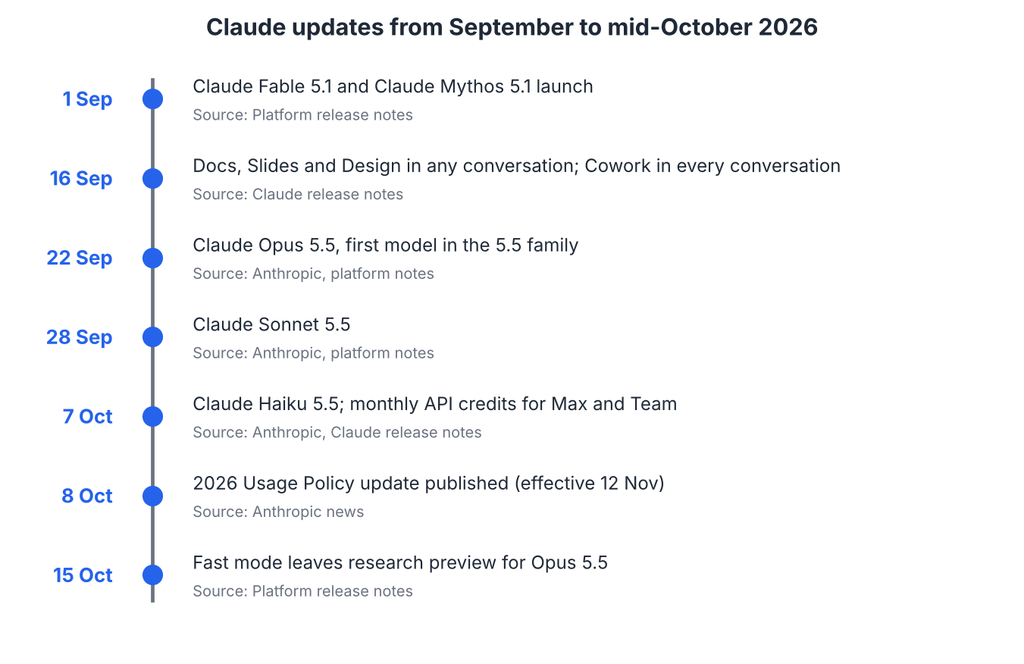
The Claude 5.5 model family
The main story is a family of three models released within about three weeks. They sit alongside Claude Fable 5.1, which launched on 1 September. Here is what each one is for, according to Anthropic.
Claude Opus 5.5: the new leading model
Anthropic’s Opus 5.5 launch page calls it the first model in the 5.5 family and its new leading model for agentic coding, computer use and knowledge work. Anthropic says it performs at the level of Claude Fable 5.1 on most work and costs about 40% less than Opus 5 on typical workloads at default settings. Those are company claims, and Anthropic itself notes that benchmark margins are a weak guide to real-world differences.
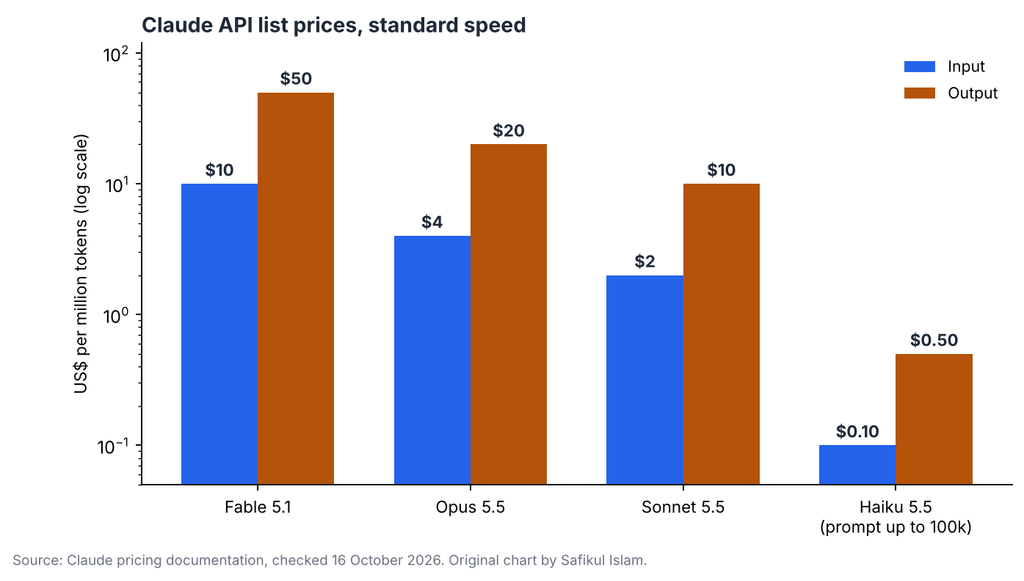
The practical details matter more. Opus 5.5 is listed at $4 per million input tokens and $20 per million output tokens, with a 1M-token context window. Extended thinking can no longer be turned off. It is available on Amazon Web Services, Google Cloud and Microsoft Azure as well as Anthropic’s own platform, and usage limits increased on Pro, Max, Team and seat-based Enterprise plans.
Claude Sonnet 5.5: faster everyday work
Sonnet 5.5 launched on 28 September at the same base price as Sonnet 5: $2 input and $10 output per million tokens. Anthropic says it generates output more than 30% faster and can cost up to 30% less per task, mostly because it uses fewer tokens. It positions the model for well-scoped everyday work such as bug fixes and preparing documents, slides and spreadsheets, and says Opus 5.5 remains stronger on complex, open-ended work.
On 7 October, Anthropic’s Platform release notes say Sonnet 5.5 cache reads were cut from $0.20 to $0.10 per million tokens, which helps long agentic sessions that reuse large prompts.
Claude Haiku 5.5: the small, cheap model
Haiku 5.5 arrived on 7 October. Anthropic calls it the cheapest, fastest and most capable small model it has released, aimed at high-volume, cost-sensitive work such as summaries, classification and database queries, and as a fast subagent. It is the first Haiku-class model with adjustable effort, and the page says it is less suited to complex agentic coding.
Pricing is where Haiku 5.5 differs. It is the only 5.x model priced by prompt length: $0.10 input and $0.50 output per million tokens for prompts up to 100,000 tokens, and $0.50 and $2.50 above that. Anthropic also says it uses slightly more tokens per task because of an updated tokenizer, so measure real usage rather than comparing price lists alone.
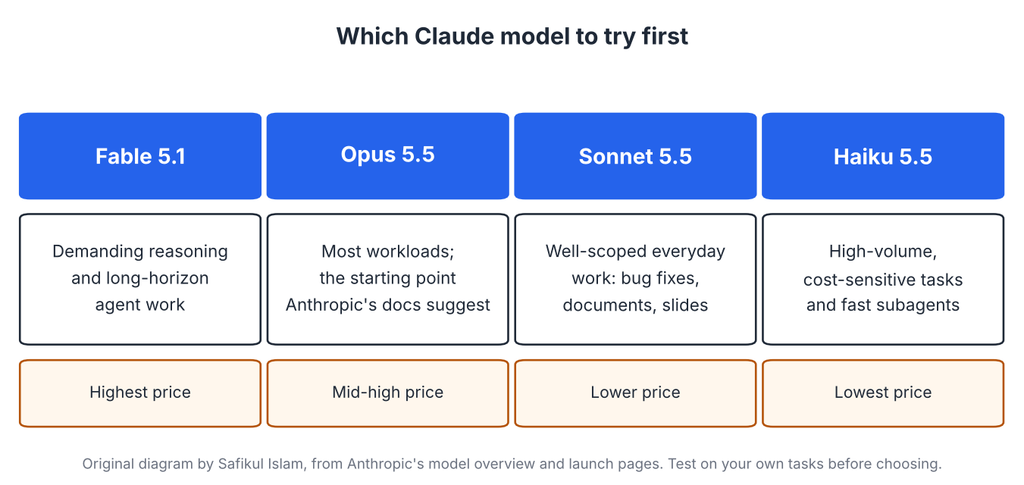
Which model should you try first?
Anthropic’s model overview suggests Opus 5.5 for most workloads and Fable 5.1 for demanding reasoning and long-horizon agentic work. That is a starting point, not a verdict. The only fair test is to run the same real tasks on two models and compare quality, time and cost.
My suggestion: pick ten representative tasks, record correctness, review time and total cost on each model, and choose the cheapest one that meets your standard. A cheaper answer that needs several corrections is not cheaper.
Safeguards you may notice
Anthropic’s launch pages describe cybersecurity and biology safeguards on the new models. For Opus 5.5, cybersecurity requests it considers high risk can be handled by an earlier model, and for Sonnet 5.5 higher-risk cyber tasks fall back visibly to Sonnet 5. Anthropic says routine software development is unaffected, and it runs a Cyber Verification Program and a Life Sciences Verification Program for organisations that need broader access. If your security team is doing defensive work, read those pages before you rely on a model.
New Claude app features
The Claude release notes list several changes for people who use Claude in the apps rather than the API.
- Docs, Slides and Design in any conversation (16 September). You can ask for a design, deck or document in any conversation, including Claude Code and the Artifacts tab. Artifacts, including these tools, are available on every plan including Free, and on Enterprise plans they are in beta and off by default until an owner turns them on.
- Cowork in every conversation (16 September). Cowork’s capabilities are available without choosing a mode first, rolling out gradually to Pro and Max on web, desktop and mobile. Chats, tasks, projects, connectors and skills carry over.
- Monthly API credits for Max and Team (7 October). These plans now include credits for running your own apps and agents on the Claude Platform. To claim them, link a Claude Console organisation in billing settings.
- Plugins for Claude (25 September). Developers can submit plugins to the Claude directory through a new developer portal and track review and usage.
- Salesforce in Claude (15 September, beta). A plugin that brings accounts, opportunities and pipeline into Claude, only for organisations Salesforce approves.
- Smart reports (10 September, Enterprise beta). Reports on how a team uses Claude, including costs, friction and repeated patterns.
Anthropic’s product announcements page also lists Claude working with Google Docs, Sheets and Slides through a new add-on and beta connectors for Enterprise (6 October), and a way to customise Claude Code with mods (1 October). Some trackers also report newer app additions that I could not find in Anthropic’s own release notes, so I have left them out until Anthropic confirms them.
If you lead a team, the Enterprise defaults deserve a look. Several of these features are in beta and off until an owner enables them, so a colleague saying “I do not see it” may simply be a settings question.
Claude API and developer changes
The Platform release notes have the dated detail. These are the changes I would check first if you build on Claude.
| Date | Change |
|---|---|
| 15 October | Fast mode is out of research preview for Opus 5.5 and no longer needs access approval or the beta header; it is also available on Claude in Microsoft Foundry. Fast mode is listed at $8 input and $40 output per million tokens. |
| 14 October | OpenTelemetry export launched in beta for tracing Messages API requests and Managed Agents sessions |
| 9 October | Managed Agents dynamic workflows in beta, letting agents run multi-phase workflows |
| 7 October | Haiku 5.5 launched with a 1M context window and adaptive thinking. Several Haiku 4.5 request patterns now return 400 errors, including budget_tokens, sampling parameters and prefill |
| 30 September | Claude Sonnet 4.5 deprecation announced, with retirement on 30 November 2026 |
| 28 September | Sonnet 5.5 launched. Code written for Sonnet 5 can break in five ways, including a thinking value that must change from “disabled” to “between_tools” |
| 22 September | Opus 5.5 launched with always-on adaptive thinking |
| 1 September | Fable 5.1 and Mythos 5.1 launched at $10 input and $50 output per million tokens, with 30-day data retention required |
Two items are easy to miss. The Haiku 4.5 patterns that now return errors will break an old integration the moment you switch models, and the Sonnet 4.5 retirement date is a hard deadline. Test your calls against the new models in a staging setup first, using Anthropic’s migration guides.
If you are building agents, my guides on how to build an AI agent and AI automation ideas for small businesses show how to start with a narrow, reviewable task.
Policy and company news
Anthropic’s 2026 Usage Policy update was published on 8 October and takes effect on 12 November 2026, with the earlier version applying until then. Anthropic says most changes clarify existing rules. The main ones, in my reading of the post, are:
- A consolidated section on fake accounts, fabricated news sites and influence operations.
- A narrower elections section focused on deceiving voters or disrupting elections, replacing the blanket ban on personalised vote and campaign targeting.
- Clearer rules on surveillance, including tracking people without consent and using Claude to decide who police should investigate, arrest or charge.
- Explicit weapons-related wording, and new requirements when Claude controls hardware: a qualified operator who can stop it and a safe state if Claude disconnects.
- A rule against sustained, needless abuse of Claude models, in extreme cases, and clearer treatment of entities controlled from unsupported regions.
If you run a business that builds on Claude, read the full policy before 12 November, especially if your product touches elections, surveillance, hardware or user accounts.
Anthropic’s news page also lists posts on the Cyber Mission and an expanded Cyber Verification Program (6 and 8 October), a $100 million commitment to train 10,000 engineers (2 October), a Singapore office and government agreement and a post on preparing for the 2026 US midterms (14 October), and an update on independent evaluators (15 October). I have not summarised those posts here, so read them directly if they matter to you.
What I would do this week
| If you are… | A sensible first step | What to check |
|---|---|---|
| An everyday Claude user | Try one real task in the model your plan offers | Quality, speed and how quickly you reach limits |
| A Max or Team subscriber | Link your Console organisation to claim API credits | Where the credits appear in billing |
| An Enterprise owner | Review which beta tools are off by default | Docs, Slides, Design and connector settings |
| A developer | Test Sonnet 5.5 and Haiku 5.5 migrations in staging | Errors from removed parameters; the 30 November retirement |
| A product owner | Read the Usage Policy changes | Elections, surveillance, hardware and account rules |
Choose one recurring task, test the matching model, and compare the checked result against your current method. A new model earns its place when it saves review time or money, not because the announcement is exciting.
My perspective on the latest Claude changes
The pattern across these releases is a family of models at different price points, with more of the work moving into documents, decks, designs and agents. That makes choosing the right model for the task more valuable than chasing the newest name.
My advice is simple. Test one task, measure how much checking the result still needs, and let your own results decide. If you want your content to be found in AI answers as well, my guide to optimising for AI search explains how to structure and source it.
Frequently asked questions
The newest model is Claude Haiku 5.5 (7 October 2026), following Sonnet 5.5 (28 September) and Opus 5.5 (22 September). The newest dated platform change I found is fast mode leaving research preview for Opus 5.5 on 15 October.
There is no single best one. Anthropic describes Opus 5.5 as its leading model for agentic coding and knowledge work and suggests it for most workloads, Fable 5.1 for demanding long-horizon work, Sonnet 5.5 for well-scoped everyday tasks and Haiku 5.5 for high-volume, low-cost work. Test on your own tasks.
Standard per-million-token prices are $10 input and $50 output for Fable 5.1, $4 and $20 for Opus 5.5, $2 and $10 for Sonnet 5.5, and $0.10 and $0.50 for Haiku 5.5 on prompts up to 100,000 tokens. Batch processing is listed at 50% off, and caching changes the effective cost, so check the pricing page.
Claude has a free plan, and Artifacts including Docs, Slides and Design are available on every plan including Free. Model access and usage limits vary by plan, so check the Claude Help Center for your account.
Yes. A 2026 Usage Policy update was published on 8 October and takes effect on 12 November 2026. Anthropic says most changes clarify existing rules, with updates to surveillance, weapons, elections, hardware control and supported regions.
Use Anthropic’s news page, the Claude release notes for app changes and the Platform release notes for the API. Check the date and the availability line before you share any update.