
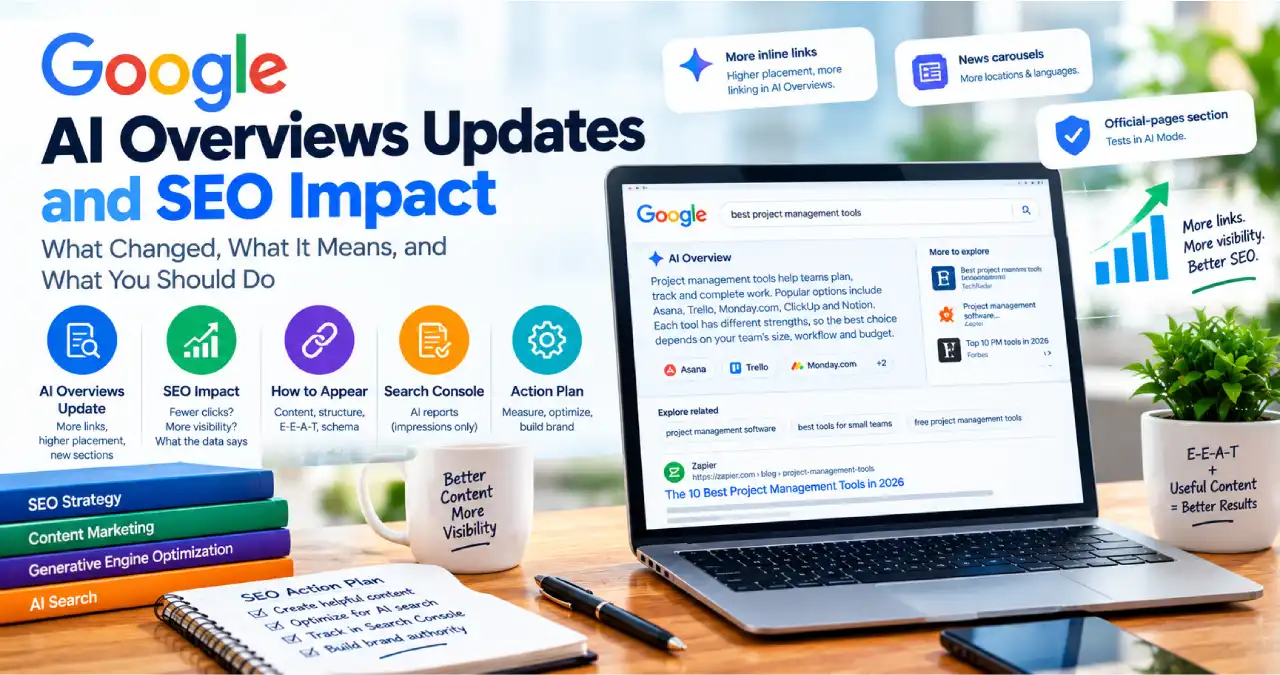
The latest Google AI Overviews update, announced on 15 October 2026, adds more inline links to AI answers, places them higher, and tests a section for official pages. In its own post, Google calls this “continued and substantial increases” in inline links. For SEO, the practical meaning is simple: AI Overviews are staying, they are linking out more, and your plan should rest on measurement and useful content, not on tricks.
I write about SEO and AI search for site owners, and I run Leelija, a web development and SEO company. I have not run controlled tests on AI Overviews, so this article sticks to what Google says and what named studies found. I tell you where the evidence is thin.
Key takeaways
- Google says there are no extra requirements to appear in AI Overviews: your page must be indexed and eligible to show with a snippet.
- Studies find fewer clicks when an AI summary appears, but they measure different things and Google disputes the picture.
- Search Console now has beta AI reports, but reportedly impressions only, with no clicks.
- The October update adds links. Whether that returns clicks to publishers is not yet shown by data.
What are Google AI Overviews?
AI Overviews are AI-generated summaries that appear at the top of some Google results, with links to supporting pages. AI Mode is a separate, more conversational search experience for longer, multi-step questions. Both can use “query fan-out”, which means Google runs several related searches behind one question and can surface a wider set of links.
Google says AI Overviews appear only when its systems decide they add value beyond classic results, so they often do not trigger.
Google AI Overviews update timeline for 2026
| Date | What changed | How well sourced |
|---|---|---|
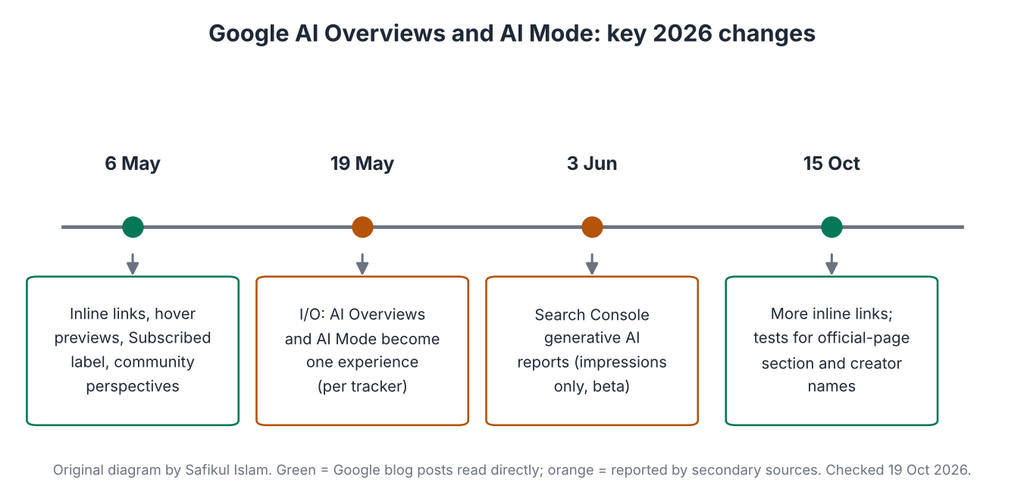
| 15 October 2026 | More and higher inline links; news carousels expanding to more locations and languages; tests of an official-pages section and clickable creator names in AI Mode video results | Google blog post, read directly. Only the carousel expansion is described as rolling out |
| 3 June 2026 | Search Console “Search Generative AI performance reports” announced; expanded to more sites on 23 June | Google Search Central post exists; details reported by secondary sources (impressions only, beta) |
| 19 May 2026 | Reports say AI Overviews and AI Mode became one integrated experience at Google I/O; AI Overviews passed 2.5 billion monthly users | Secondary tracker (Keywords Everywhere); confirm in Google’s own I/O posts |
| 6 May 2026 | Five updates: inline links beside text, desktop hover previews, “Subscribed” label, suggested follow-up articles, community perspectives | Google blog post, read directly; no regions or timeline given |
A caution on the table: Google has not published a full rollout schedule by country or language for most of these changes. Treat them as product direction, not as something that is live for every searcher.
The October 2026 update, in plain terms
- Inline links: Google describes continued and substantial increases to inline links in its AI experiences, shown higher in responses more often.
- News carousels: prominent carousels for timely articles are rolling out to more locations and languages, highlighting Preferred Sources. Google says Preferred Sources use has grown more than 7x this year, with no base figure.
- Related links: links at the end of some AI responses get image thumbnails and a more clickable design.
- Test: a separate section at the top of a response linking to official sites, with a note on why each link helps.
- Test: clickable creator and publisher names on AI Mode video results, linking to their Search profiles.
Barry Schwartz at Search Engine Land notes that Google still does not provide click data for inline links in its Search Console AI reports, so you cannot yet see whether the extra links send traffic.
Do AI Overviews hurt SEO? What the data says
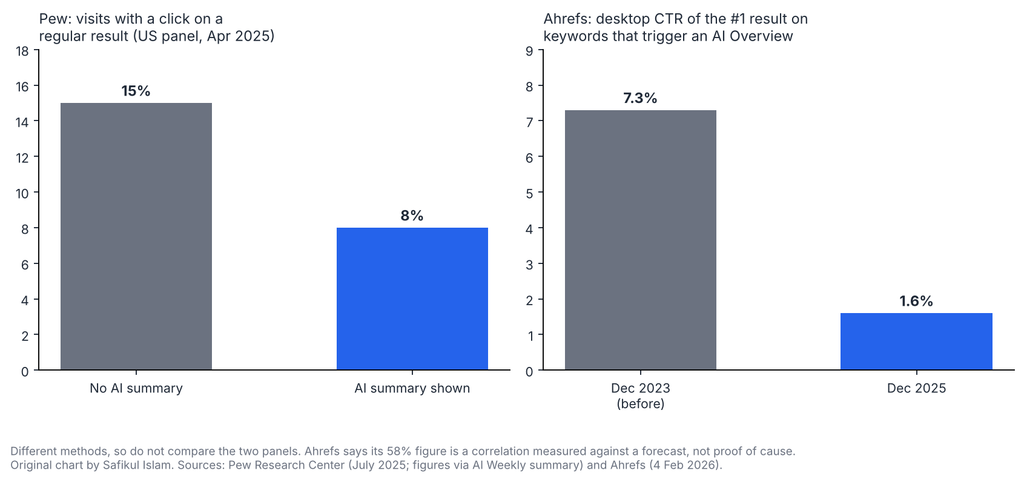
Pew Research Center tracked 68,879 searches from 900 US adults in April 2025. Users clicked a regular result in 8% of visits when an AI summary appeared, against 15% when it did not, and clicked a link inside the summary in about 1% of visits (figures from AI Weekly’s summary of the study).
Ahrefs compared 150,000 keywords with an AI Overview and 150,000 informational keywords without one. It found the desktop click-through rate of the top result fell from 7.3% in December 2023 to 1.6% in December 2025, about 58% below what its forecast expected. Its earlier April 2025 study found 34.5%. Ahrefs itself says this is correlation, desktop-only and based on a forecast, and it is an SEO software vendor.
So the honest answer is: yes, several studies link AI summaries to fewer clicks, but the size varies by method, query type and period. Trackers that estimate how often AI Overviews appear also disagree, with figures from roughly 39% to 48% depending on the method (as reported by the Keywords Everywhere tracker). Do not add these numbers together, and do not assume your site matches the average.
Google’s view, as reported by the same tracker, is that organic clicks are “relatively stable”. I could not find Google data that settles the argument, so I would watch your own Search Console and analytics.
What Google says about appearing in AI Overviews
The most useful page here is Google’s own AI features documentation, last updated in December 2025. Its main points are:
- There are no additional requirements. Your page needs to be indexed and eligible to appear in Search with a snippet, and even that does not guarantee it will appear.
- You do not need special markup, AI text files or new schema.org structured data.
- Follow standard SEO: let Google crawl your pages, use internal links, give a good page experience and keep important content in text.
- Make sure structured data matches the visible text, and keep Merchant Center and Business Profile information current.
- AI feature traffic is included in the Web search type in Search Console performance reports.
- To limit what is shown, use nosnippet, data-nosnippet, max-snippet or noindex. Google-Extended controls some other Google AI uses.
That is useful because it cuts through the noise. If an agency promises a special trick to “get into AI Overviews”, compare it with this page.
Search Console and measurement
Google announced Search Generative AI performance reports in June 2026 (Search Central post). Secondary summaries say they show impressions for your pages in AI Overviews, AI Mode and some Discover features, by page, country, device and date, but not clicks, click-through rate, position or queries. They are in beta and rolling out gradually, so you may not see them yet.
Until click data arrives, I would compare Search Console Web clicks for informational pages before and after the dates above, and watch conversions, leads and branded searches in your analytics. Google itself suggests tracking conversions and engagement, and says clicks from AI features tend to be higher quality. I could not verify that claim independently.
How to adapt your SEO strategy
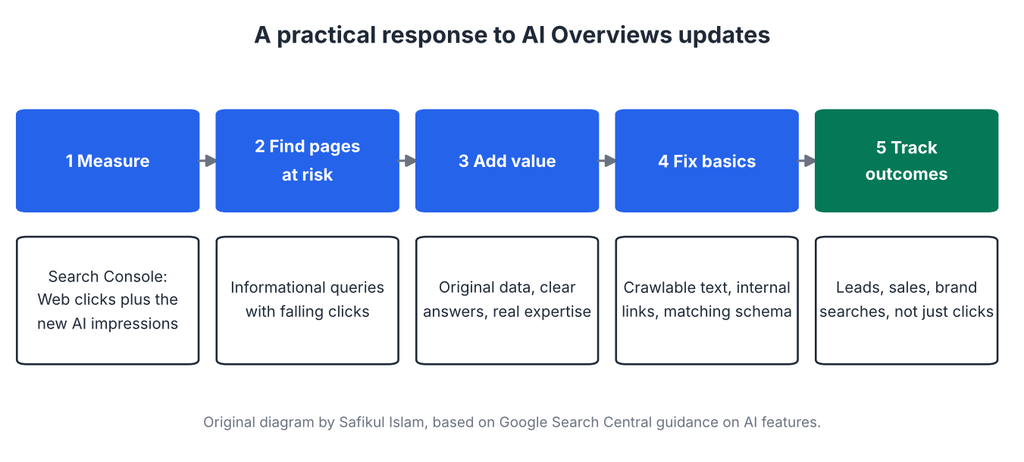
1. Measure before you rewrite
Do not rewrite your whole site because of one announcement. Pull a baseline of clicks, impressions and conversions for your main pages. If you add a new report, start a monthly log.
2. Find the pages that are most exposed
Pages that answer simple definitions or quick facts are the most likely to be summarised. Pages that need a tool, a template, original data, a calculator or a decision are harder to replace with a summary.
3. Add something an AI summary cannot
Examples: your own data, a worked example, screenshots, a comparison with your reasoning, a downloadable checklist or an expert opinion. This is also what readers want, which is the point of Google’s guidance.
4. Keep the basics clean
Put the direct answer near the top, use clear headings, keep important content in text, link related pages and keep titles honest. Use structured data only when it matches the visible page. For more detail, read my guide on optimizing for AI search.
5. Build brand and entity signals
Official pages, a current Google Business Profile, consistent names, reviews and mentions on trusted sites help people and systems recognise who you are. Google’s October test of an official-pages section suggests clear business pages may matter more, though that is an inference, not a Google statement.
6. Track outcomes, not only clicks
If fewer people click but more of them buy, call or contact you, your SEO may still be working. For a service business such as Leelija, I would watch enquiries and branded search, not just sessions.
Myths to ignore
- “You need a special AI schema.” Google says no new structured data is needed.
- “You can guarantee a place in AI Overviews.” No one can. Google says even meeting the requirements guarantees nothing.
- “SEO is dead.” The same fundamentals appear in Google’s own AI documentation.
If you are building with AI tools yourself, my guide on how to build an AI agent and my other AI guides may help.
Frequently asked questions
On 15 October 2026 Google said it is showing more inline links in AI Overviews and AI Mode, placing them higher, expanding news carousels and testing an official-pages section.
Several studies, including Pew and Ahrefs, link AI summaries to fewer clicks on regular results. The size depends on method and period, and Google says organic clicks are relatively stable.
Google says there are no extra requirements beyond being indexed and eligible to show with a snippet. In practice, publish useful, original, crawlable content. No one can guarantee a citation.
No. Google says no new structured data is needed, and any structured data should match the visible text.
You can limit what Google shows from your pages with nosnippet, data-nosnippet, max-snippet or noindex. These controls also affect normal snippets, so test the trade-off first.
AI feature traffic is included in the Web search type. Google also announced beta generative AI reports that reportedly show impressions only. Check whether your property has them.