
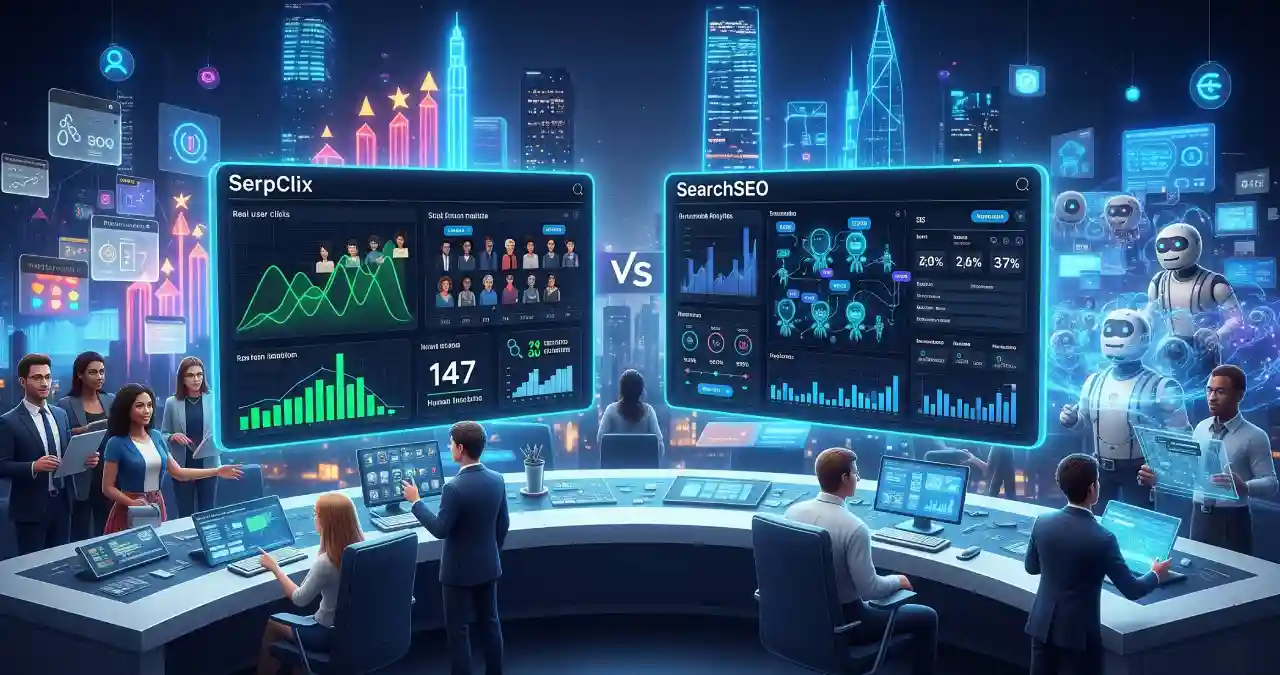
SerpClix and SearchSEO are both CTR (click-through rate) services: they sell clicks on your search listing in the hope of lifting your rankings. Neither can guarantee higher rankings, and using paid or automated clicks to influence search results carries real risk. If you want lasting traffic, a better title, better content and real links will do more than bought clicks.
I get asked about these tools because they show up in SEO forums and comparison pages. This guide explains how each one describes itself, what the risks are, and what I would do instead. I have not tested either service, so I am not going to claim results from them.
Quick answer
- SerpClix: markets a network of people who search your keyword, find your listing and click it.
- SearchSEO: markets automated “CTR bot” visits that imitate human searches.
- Common risk: both aim to influence search signals artificially. Google says it may act against any spam practice it detects.
- My advice: do not build your SEO on bought clicks. Fix your titles, content and links first.
What a CTR tool is supposed to do
The idea behind these services is simple. A person or script searches a keyword on Google, scrolls to your result, clicks it and stays for a while. The seller claims this behavior tells Google your page is popular for that query.
Google has not confirmed that this works, and independent proof is thin. Treat any seller’s ranking claims as marketing until you see evidence you can verify yourself.
SerpClix vs SearchSEO at a glance
| Question | SerpClix | SearchSEO |
|---|---|---|
| How it describes itself | Clicks from a network of human searchers | Automated CTR traffic |
| Main promise | More clicks on your search listing | More clicks and visit activity |
| Ranking guarantee | None that I can verify | None that I can verify |
| Main risk | Artificial signals, wasted budget | Automated traffic, artificial signals, wasted budget |
Check each vendor’s own site for current pricing and terms. These change, and I do not want to quote numbers I cannot verify.
The risks you should know about
- Policy risk. Google’s spam policies cover attempts to manipulate search systems and say Google may act against any spam practice it detects. Its policy on machine-generated traffic also treats automated queries as a violation.
- Wasted money. Even if clicks register in Search Console, that does not mean rankings follow.
- Bad data. Fake visits distort your analytics, so you cannot tell what real users want.
- No fix for weak pages. If your content does not satisfy the searcher, extra clicks will not hold a ranking.
What I would do instead to raise CTR
Real CTR improvement comes from making your listing worth clicking. These steps are slower, but they build something you keep.
- Find pages with high impressions and low CTR in Google Search Console.
- Rewrite the title to match the search intent and include the main keyword early.
- Write a meta description that gives a clear reason to click.
- Answer the question first on the page, then add detail.
- Add FAQs and sources so both users and AI search tools can quote your page.
- Build real links through useful content and honest outreach.
For more on this approach, see my SEO and digital marketing guides.
FAQs
What is the difference between SerpClix and SearchSEO?
SerpClix describes a network of human searchers who click your result. SearchSEO describes automated CTR traffic. Both are paid attempts to influence click signals.
Do CTR bots improve Google rankings?
I could not find reliable proof that they do, and no vendor can guarantee it. They also carry spam-policy risk.
Is buying clicks safe for my site?
It is not risk-free. Google says it may act against any spam practice it detects, so I would avoid it for any site you care about.
What is a safer way to raise CTR?
Improve your titles and meta descriptions, match search intent, and add useful content. Use Search Console to find pages that need it most.
Source: Google Search Central, Spam policies. Last reviewed October 20, 2026. This article replaces earlier posts on SearchSEO, ClickSEO and CTR bots.